Key takeaways
- Resource management is the process of identifying, allocating, and utilizing project resources in the most strategic way to ensure efficiency and maximum value
- Resource management encompasses human, financial, and material resources. It requires clear goal setting, cross-department communication and transparency, strategic resource allocation, and continuous monitoring and adjustments as necessary
- The benefits of resource management include enhanced productivity and efficiency, more balanced workloads, improved employee engagement, and greater visibility to ensure projects are delivered on time and within budget
- Using resource management software to streamline the process frees up time for strategic tasks and reduces admin for more consistent, transparent, and scalable resource management
Resource management has been traditionally seen as an administrative and reactive practice, typically completed using basic tools like spreadsheets. But with significant technological leaps and a dominant people-first culture within professional services firms today, the practice of managing resources has repositioned itself to offer real strategic value to firms - especially those with billable resources.
In this guide, we explore the importance of resource management and the benefits of utilizing resource management software to transform the practice.
Contents
1. What is resource management?
2. Why is resource management important?
3. Types of resource management
4. Benefits of resource management
5. Common resource management challenges and how to overcome them
6. 6 proven resource management techniques
7. Resource management best practices
8. How to create a resource management plan
9. Benefits of using resource management software
10. What types of resources require management?
11. Who is responsible for resource management?
12. What’s the best way to measure the success of resource management?
13. How do I know if a project requires a resource management plan?
14. Transform resource management with Dayshape
What is resource management?
Resource management is the process of planning, scheduling, and allocating organizational resources in the best way possible to maximize the value and potential of your resources. Resource management is crucial for any professional services firm and plays a significant role in ensuring both business profitability and sustainability.”
Although dealing with the organization of people, resource management is not to be confused with human resource management, which involves the recruitment, training, development, and performance management of employees.
Why is resource management important?
Effective resource management is vital to protect, support, and utilize the firm’s most valuable assets to its strategic advantage, making the management of resources a core driver of operational success. Implemented correctly, an optimal resource management strategy can increase efficiency, improve profit margins, and positively impact client and employee satisfaction.
Suboptimal resource management can lead to poor productivity, costly delays, client dissatisfaction, and revenue leakage. The resulting pressure placed on teams can lead to low morale, retention issues, and an inability to deliver to meet client expectations. Without the ability to leverage the right resources at the right time, a firm becomes unable to maximize its existing business or seize new value-generating opportunities. Effective resource management directly links the quality of its practices to the success of the firm.
Types of resource management
There are several different types of resource management, depending on the resources requiring allocation and monitoring. The most common types of resource management include:
1. Human resource management
Human resource management concerns people, and their skills, as resources. This type of resource management involves recruiting, training, and retaining skilled people; for example, by creating a positive workplace culture, and ensuring resources are assigned to projects that are a good fit for their expertise and personal or career development interests.
2. Financial resource management
Financial resource management is about ensuring a budget and any other financial assets are used in the most efficient way to deliver a project. Budgeting and forecasting are a key part of this, and are necessary to support strategic decision making to enhance an organization’s overall financial performance, while delivering work in line with clients’ budgets.
3. Material resource management
Material resource management is concerned with the acquisition and utilization of the materials necessary to complete a project. This is essential to ensure a steady supply of the required materials to prevent any delays to overall project delivery.
4. Project resource management
Each of the types of resource management above feed into overall project resource management. Managing project resources can be a wide-ranging task, encompassing the planning, allocation, and optimization of resources to ensure projects are delivered on time and within budget.
Project resource management also requires the continuous monitoring and adjustment of resources to respond to any changes in scope, timelines, budget, or other factors. Project resource managers are responsible for ensuring projects remain aligned with goals and budget, despite any unexpected changes.
Benefits of resource management
Now we have covered what resource management is and the importance of getting it right, let’s consider the benefits of resource management for professional services firms. An effective resource management process can enable your firm to:
1. Maximize resource utilization and revenue
Where employees are highly specialized, have multiple reporting lines and are spread geographically, leveraging these resources in the best possible way can be incredibly challenging. A good resource management system can help your firm to overcome these complexities, deploy resources strategically, and proactively identify revenue opportunities. This will enhance productivity by helping to ensure the right resources are allocated to the right tasks.
2. Reduce overruns and resource-related costs
By improving productivity and maximizing billable and strategic resource utilization, an effective resource management process can enable your firm to reduce its costs. Increasing efficiency while reducing the risk of overruns can be achieved by ensuring that the right combination of skills are assigned to the right client or project every time. When optimized, resource management can also reduce the cost related to staff turnover by supporting employee engagement.
3. Improve employee engagement and retention
Implementing a resource management process can help professional services firms to drive better utilization, employee satisfaction, and retention simultaneously. By taking into account individual preferences, interests, and career aspirations when allocating work, your firm can better support your employees’ development and growth.
4. Increase engagement visibility and business agility
Effective resource management is essential to maintain visibility of capacity, monitor and adapt to ongoing changes, and identify resourcing risks. Resource management processes that increase transparency, and visibility of capacity and utilization will provide your firm with greater control when faced with clashes or disruptions.
Data-driven decision making is vital for strategic resource management tasks. The insights gained facilitate the rapid re-optimization of resources, and allow your firm to proactively take corrective actions ahead of time. Minimizing disruptions and delays on projects will also benefit teams and client service as a result.
Common resource management challenges and how to overcome them
Resource management can be a complex task, requiring inputs from multiple stakeholders, which can lead to challenges. Utilizing resource management software can help to overcome many of these challenges, including:
- Poor visibility: lack of visibility into team capacity, skills and project timelines creates significant challenges, but using centralized tools that all stakeholders have access to will improve transparency and tracking
- Forecasting inaccuracies: if resource forecasting is inaccurate, this will impact efficiency and project timelines. Resource management software can provide you with historical data into resource usage to help improve the accuracy of future forecasting
- Unbalanced workload: uneven workloads can result in burnout or job dissatisfaction due to overutilization, while skills gaps can lead to a mismatch between skills required vs skills available. Resource managers can use resource leveling to amend project schedules to better distribute tasks and rebalance workloads
- Conflicting priorities: if priorities are unclear, prioritization and cross-department collaboration will be required to ensure effective resource utilization. Data-driven insights provided by your resource management software can also help to determine priorities and ensure strategic utilization
- Poor communication: lack of communication can lead to misunderstandings and subsequent project delays. Improved visibility via a dedicated resource management platform and encouraging a culture of open communication can help to prevent this and avoid any bottlenecks
6 proven resource management techniques
Resource management relies on a range of interlinked processes and techniques, including planning, allocation, scheduling, utilization, leveling, and forecasting. Each technique measures and monitors resource-related metrics from a different angle, and all share the common goal of maximizing the use, visibility, and value of a firm’s resources. Let’s take a closer look at some of the key resource management techniques.
1. Resource planning
Resource planning is the foundation of any resource management strategy. It involves the strategic assessment of resource capacity, availability and budget vs the level of resource required. In other words, resource planning is the process of identifying and forecasting resource requirements and preparing a plan to secure the resources to meet them. The key to resource planning is developing a strategy that addresses ongoing resource requirements consistently, on time, and on budget.
2. Resource allocation
Resource allocation is the process of assigning appropriate and available resources to a task or project in support of business objectives. The aim of resource allocation in professional services is to achieve objectives in the most effective and efficient way. This means ensuring that the right skills, qualifications, and experience are matched to the right jobs at the right time. Resource allocation also takes into account the availability, capacity, and utilization of resources across a firm.
3. Resource scheduling
Scheduling is a crucial part of the resource planning process and usually follows resource allocation. Once resources have been identified and allocated based on the best match of skills and experience for an engagement, a resource manager will then schedule these resources for a specific time and task.
The resource scheduling process should ensure that the resources with the skills, experience, and qualifications necessary are scheduled for the right task and at the right stage of the engagement. Effective resource scheduling is essential to maintain efficiency, avoid resource clashes, and keep engagement performance on track.
4. Resource utilization
Resource utilization measures the efficiency of resource usage, and signals whether the resources that make up the core cost base of a firm are being used in the most effective way. Resource utilization also takes into account non-billable time; for example, for internally focused work, such as training.
Low overall resource utilization can hinder your firm's ability to yield a positive return on your employees' time and expertise. Conversely, consistently overutilizing your workforce risks staff burnout and leaves no room for additional revenue-generating work. Achieving the right balance is a complex and ongoing optimization process.
5. Resource leveling
Resource leveling involves amending the start and/or end date of a project in order to balance resource demand with the available supply. This resource management technique helps to prevent the overallocation of resources, and minimizes the likelihood of project delays, as realistic, achievable timelines for delivery can be set from the start. Resource leveling can therefore help to increase efficiency and productivity, reduce the risk of staff burnout, and better manage client expectations.
6. Resource forecasting
In professional services, resource forecasting is the process of predicting a firm’s future resource requirements to ensure that upcoming projects are adequately and effectively staffed. The resource forecasting process measures actual resource capacity vs expected demand, and informs strategic decision-making regarding resource allocation and recruitment. Firms also use resource forecasting to assess whether they possess the necessary skills and capacity to pursue new growth opportunities.
Resource management best practices
Ensure efficient resource usage by following these resource management best practices:
- Establish clear goals: effective resource management requires clear goals and objectives to ensure resources are strategically aligned with commercial priorities
- Allocate resources strategically: when allocating resources, try to align people’s specific skills and interests with projects to support improved efficiency and job satisfaction. Make sure the workload is as balanced as possible to prevent under- or over-utilization
- Ongoing monitoring: regular monitoring and evaluation is necessary to assess resource utilization and identify where adjustments may be required to enhance efficiency further
- Open communication: ongoing communication is important to ensure successful collaboration between teams, to optimize resource allocation, and prevent bottlenecks from occurring
- Embrace technology: use resource management tools and technology to track resource usage, streamline processes, improve efficiency, and automate reporting
How to create a resource management plan
Creating a resource management provides a roadmap that outlines how resources will be identified, allocated, and tracked for a project. It can be a useful tool for monitoring project progress. Here’s how to create a resource management plan, step by step:
1. Set clearly defined SMART goals and determine priorities to ensure resources are aligned strategically with overall objectives and expected timelines
2. Identify the resources required to deliver the project in line with budget and deadlines, and assess resource availability
3. Allocate the best-match resources to the right tasks, and determine whether resource leveling or other utilization optimization strategies are required
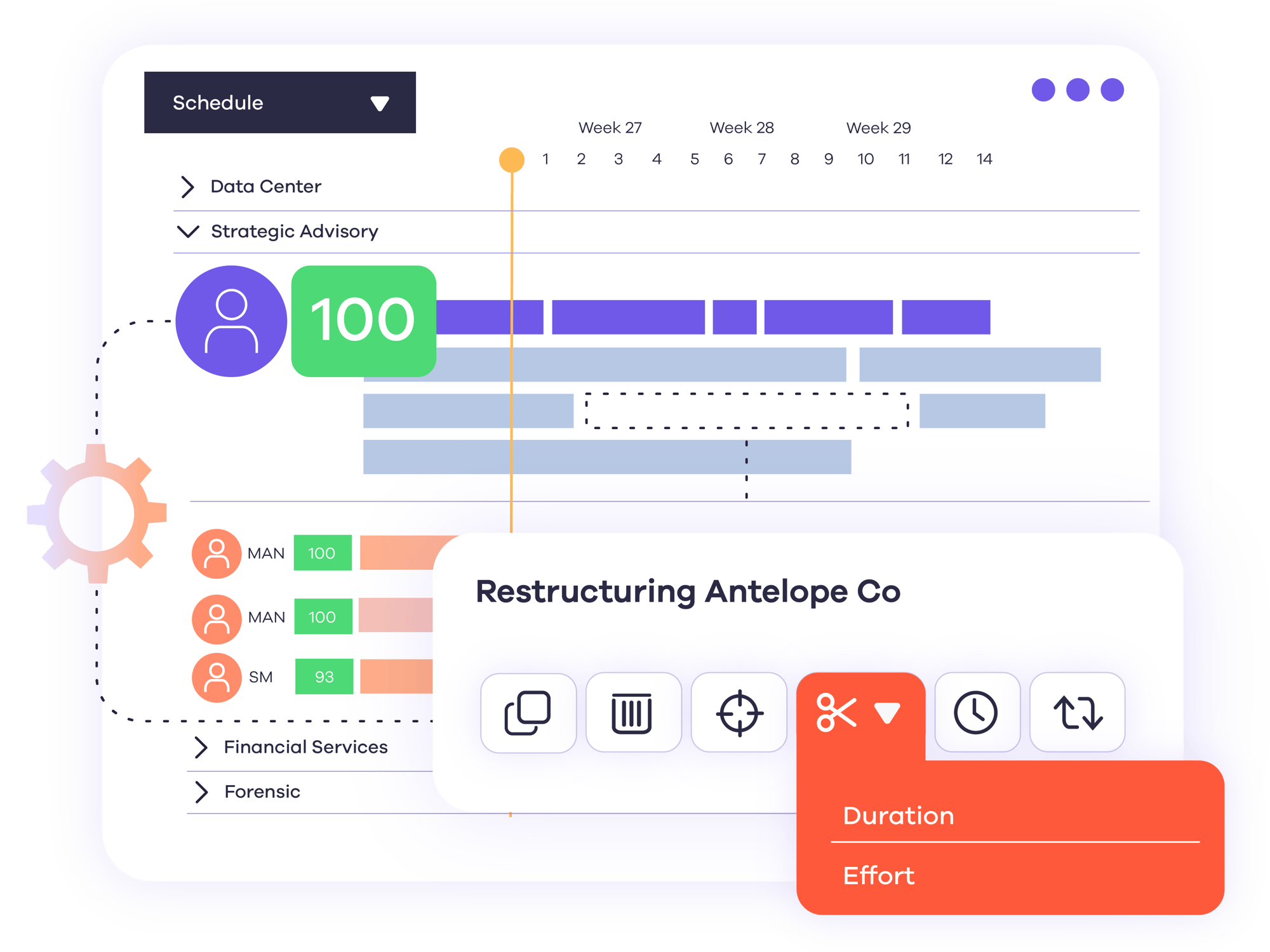
4. Schedule resources based on availability, outlining exactly when and how resources will be used throughout the project. A Gantt chart scheduler can be a useful tool for this task
5. Continue to monitor project progress once delivery is underway to identify if any resource adjustments are required for agile resource management
Benefits of using resource management software
Introducing the right resource management software solution can help your firm to optimize your workforce like never before. The benefits of using resource management software include:
- Reduce laborious administrative tasks
- Lower the risk of staff burnout
- Make faster, better-informed resourcing decisions
- Eliminate disjointed resourcing across service lines
An intelligent resource management system can help your firm to optimize your processes across resource planning, allocation, scheduling, utilisation, leveling, and forecasting. The benefits of resource management software include:
1. Automated scheduling
Reduce the admin burden on your team and optimize your resource planning with automated engagement scheduling. To streamline scheduling, resource management software automatically deploys the best-suited personnel, considering:
- Skills
- Qualifications
- Availability
- Location
- Key criteria
Automated project controls and alerts also speed up the process of resolving clashes, or prevent them from happening in the first place.
2. Live engagement economics
Make better-informed decisions faster with live engagement economics, automated project controls, and reporting all in one system. Intelligent resource management software allows you to:
- View the impact any resource changes have on your engagement financials
- Monitor actuals in real time
- Make changes to prevent reduced margins and potential overruns
3. Greater efficiency and optimization
Establishing, monitoring, and leveraging the right metrics is key to optimizing your resource management strategy. The most efficient way to measure and optimize your firm's resource management practices is to combine in-depth, data-driven insights with a powerful software solution.
Resource management FAQs
What types of resources require management?
Resource management typically deals with the allocation and utilization of human, financial, and physical resources. Human resources encompass skills, while financial resources include budgets and expenditure, and physical resources cover premises, equipment, and associated maintenance.
Who is responsible for resource management?
Different teams within an organization will be responsible for resource management:
- Resource managers: resource managers are ultimately responsible for ensuring the right resources are assigned to the right tasks, but they will work closely with other teams to ensure resource management is effective across the board
- Project managers: project managers will also play a key role in overseeing resource management, as they are responsible for overseeing the end-to-end delivery of a project, which includes managing resources
- Operations managers: in some organizations, operations managers may oversee resource management, ensuring that resources are allocated and utilized efficiently across all departments
- HR managers: HR will usually take responsibility for managing human resources, but they will need to collaborate with wider project teams to align their resources with others to ensure strategic resource management
- Senior leaders: leadership teams are responsible for establishing and communicating the policies and frameworks that will guide effective resource management throughout an organization
What’s the best way to measure the success of resource management?
There are different ways to measure the success of a resource management process. These can include:
- Measuring project delivery dates against initial timelines to assess efficiency
- Monitoring budget usage throughout a project, and again at its end
- Evaluating resource utilization rates at the end of the project, for human, financial, and physical resources
- Assessing overall outcomes following project completion against initial goals and objectives
How do I know if a project requires a resource management plan?
Not every project will require an in-depth resource management plan, but these roadmaps can be especially beneficial in professional services if:
- There are complexities to the project: if a project requires a large number of people with different skills from multiple departments, or has interdependencies with other tasks, a resource management plan will help to coordinate and align all teams
- Resource availability is limited: when there is limited resource availability, strategic planning is required to optimize usage and prevent bottlenecks or burnout
- There are budget constraints: if budget is tight, a resource management plan enables close monitoring, ensuring a project stays on budget and aligned with goals
Transform resource management with Dayshape
Dayshape’s resource management software will transform the way your organization measures efficiency and optimizes resource utilization. Ensure effective resource allocation while delivering projects on time, within budget, and in line with clients’ expectations.
Dayshape helps organizations to:
- Grow revenue
- Optimize margins
- Improve resource planning confidence
- Access data-driven insights
Book a demo, or contact us today to find out more.