Key takeaways
-
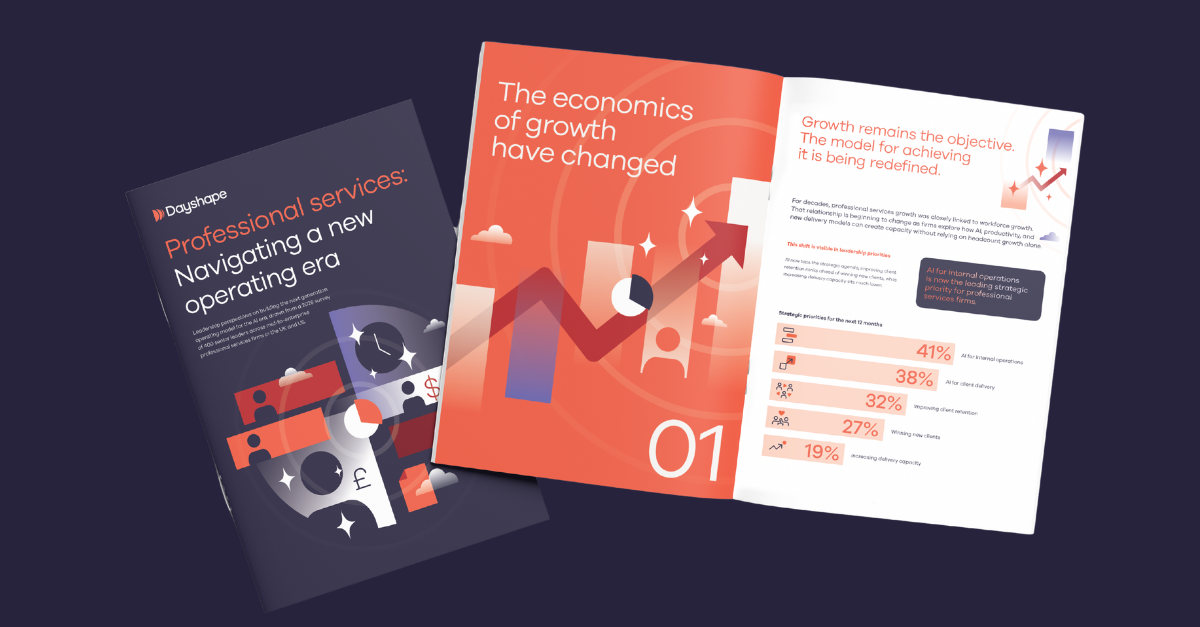
The future of professional services is being shaped by the war on capacity, a more strategic approach to resource management, and greater investment in AI-powered technology
-
The most forward-thinking professional services firms are also leveraging increasing private equity investment in the industry as a driver of operational optimization
-
The future of the professional services sector will also be defined by investment in technology that drives a clear return on investment (ROI)
-
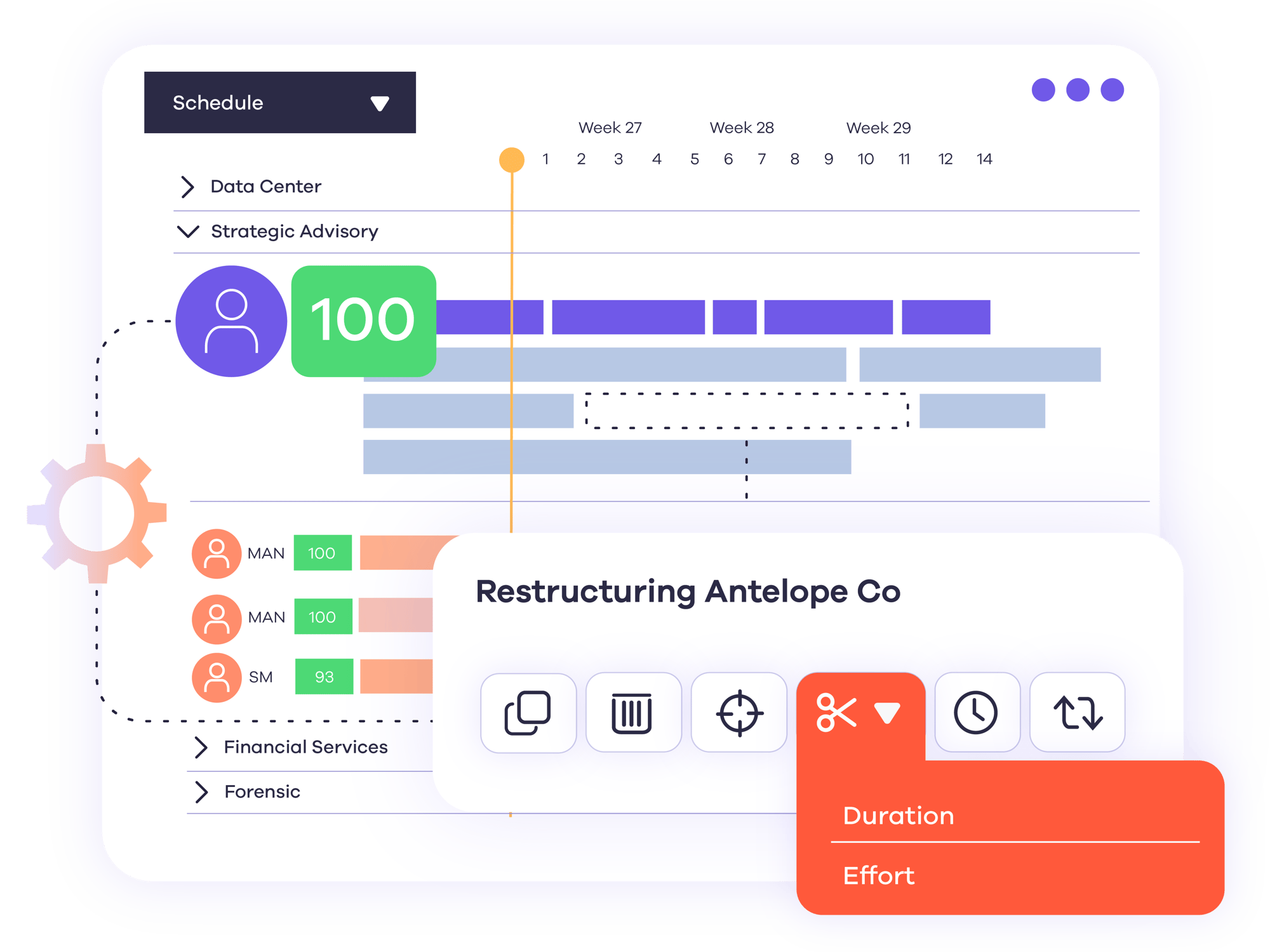
Dayshape AI-powered resource management software supports leaders to both protect and propel their top talent by actively monitoring workloads to prevent burnout, while offering competitive career paths. This will be vital as talent tides continue to shift
Contents
1. 6 trends defining the future of professional services
2. What will define the professional services firms of the future?
6 trends defining the future of professional services
Discover the priorities driving the future of the professional services sector, from adopting a more strategic approach to resource management to increasing investment in AI-powered technology.
1. Private equity investment
Private equity is fueling a shift towards a long-term investment mindset – putting operational optimization and strategic tech investment at the top of the agenda, where they belong.
There’s a growing perspective that PE involvement brings a longer-term lens, prompting more strategic investment in areas like workforce planning, data infrastructure, and technology.
Matt Cockett, CEO of Dayshape, explains: “Private equity brings a level of clarity and ambition that sharpens focus. Investors want to know what you have, where you're going, and how you’ll get there. That lens pushes firms to take a much more strategic view – of people, planning, and performance.”
By shining a light on how firms operate, highlighting inefficiencies and re-evaluating historically underinvested areas, PE investment is pushing firms to consider where the industry is heading long term. They are also reviewing where investment is needed to grow faster and more sustainably than the competition.
This mindset allows for investment in initiatives that may not yield immediate returns – such as building out modern tech stacks or adopting more advanced planning tools – but that strengthen future performance and resilience. This is a shift that prioritizes long-term growth.
Industry voices suggest this shift won’t just drive better performance, but that it could also help to re-energize the industry. Some predict that PE-backed firms will become increasingly attractive to younger professionals who are eager for change, growth, and innovation. They argue that the shake-up could breathe new life into firms and create compelling reasons for talent to stay and grow within the profession.
2. Changing talent tides
The war for talent is giving way to a war on capacity – and firms need the resourcing hindsight, insight, and foresight to plan and hire ahead of the curve, consistently and with confidence.
Talent wars have dominated headlines for much of the past few years in professional services, reflecting the industry's challenges in attracting and retaining top talent, with firms aggressively hiring to meet demand and counter high attrition. But that dynamic is shifting. Layoffs in the thousands at PwC, EY, and KPMG point to a pivot toward operational efficiency. Reports of low voluntary turnover suggest many professionals are choosing stability, and staying put longer than firms may have anticipated.
Some firms are adjusting previous demand planning that may have missed the mark, while economic pressures and private equity investment may be causing people to stay with a firm for longer. At the same time, AI is reducing the need for large teams to handle high volumes of manual or administrative work. With each of these pressures pulling in the same direction, this marks a shift from chasing headcount to maximizing capacity, with the priority shifting to retaining the right people and making every role count.
This marks a broader transition from the war for talent to the war on capacity where optimizing resources, improving workforce planning, and deploying people strategically is key. Firms need to do this not only to meet today’s demand, but to compete with the firms of the future as competition rises.
3. More strategic resource management
In professional services, every growth plan, client promise, and strategic priority ultimately hinges on having the right people, with the right skills, on the right work, at the right time.
Yet for many firms, resource management remains undervalued, and is still too often treated as a logistical function rather than a strategic lever. Resource management is too often disconnected from the decisions it directly affects, including:
-
Profitability
-
Client outcomes
-
Team health and strength
-
Growth capacity
Wayne Kaplan, former Grant Thornton Partner, explains: "There's been a wild temptation among leadership to oversimplify resource management: we have a problem, so let's tweak utilization, let's tweak leverage – that'll solve all ills. But that's way, way, way too simplistic an approach to the resource management conundrum and the strategic imperative of getting it right.
“The question shouldn't just be how do we drive profitability for the next season. It should be: how do we build a long-term, sustainable, profitable, growth-oriented practice?"
A shift in this mindset is already underway. The leading firms are taking a different view. They're not treating resource management as an admin function – they're recognizing it as a core business system that directly impacts performance, profitability, and client delivery.
Paul MacIntosh, Partner and Practice Leader at EY, reflects: "Resource management is much more than a staffing tool; it's a valuable asset. As I've gained a deeper understanding of its potential, our approach at EY has expanded. We've now integrated resource management into our strategy sessions, ensuring that staffing decisions align with the organization's broader strategic objectives."
Listen in full: The resource management podcast: Season 1
4. AI-powered technology
The AI divide is widening fast, and firms that delay proactive AI education and investment risk falling behind on performance, retention, and other ways we can't yet predict.
The market leaders are already applying AI to streamline administrative work, strengthen forecasting, and enhance planning accuracy – gains that only gain with time. The AI divide is becoming increasingly visible in areas like manual resource planning, project allocation, and capacity forecasting.
There’s also growing acceptance that AI adoption isn’t just about productivity – it’s about people. Industry leaders suggest that firms should use AI intentionally to protect and propel the careers of their top talent:
-
Protect: using AI-powered technology to monitor workloads and actively prevent burnout
-
Propel: ensuring people are staffed on projects that support their growth to offer more attractive, competitive career paths
Achieve both, and a firm is not only more likely to retain the talent it needs, but also to deploy that talent in ways that deliver stronger client outcomes.
The impact on junior professionals may be even more profound. While there has been speculation that an ‘AI intern’ may replace entry-level roles, experts suggest the opposite. Rather than replacing junior accountants, AI will reshape their work by taking on foundational tasks like data entry and reconciliations.
Some predict that, with the right investment in AI, this generation of junior professionals could gain more career-building experience in their first five years than any generation before them. That’s good news not just for talent retention, but for the long-term vitality of the profession.
And AI won’t just automate admin – it’s already assisting in judgment-based workflows, flagging anomalies, and suggesting next steps with speed and accuracy, across high volumes of work. What was once seen as a near-term possibility is here and now, so the real differentiator will be between those who treat AI as a task for tomorrow versus a priority for today.
5. Investment in value-driven technology
The most forward-thinking professional services firms will assess whether they are seeing real ROI from their investment in technology. Whether AI-powered or not, leaders need to ensure every technology investment moves the firm forward.
Although AI is top of mind, for many firms, the immediate priority is getting the foundations right – ensuring core systems, data, and processes are in place to support scale and respond to changing demands.
Matt Cockett explains: "For firm leaders focused on growth, the question becomes: 'Are we using all the tools at our disposal to achieve that growth? And are we investing in the right tools to solve the right problems—and support the firm we want to become?'"
Sam Cornish, Financial Services Partner at BDO, adds that one function that can benefit hugely from technology investment is resource management.
"I think technology plays a significant role – about a third – in enabling an effective resource management process. I say this from personal experience: using resource management software that was clunky, hard to access, or limited by licenses made it difficult to reflect the actual state of play on the system.
“The technology you choose needs to be intuitive, easily accessible, and capable of real-time updates. It should empower users to identify and solve problems independently, without always relying on a central resource management team.”
Listen in full: The resource management podcast: season 2
6. Long-term thinking
Preparing for the future of professional services requires a long-term strategic mindset. Firms need to ask themselves whether they are making decisions like a high-performing company in order to succeed.
The firms setting the pace for the future are no longer just reacting to what's in front of them; they're looking ahead –years ahead – and making strategic moves and investments today that will define their trajectory tomorrow.
Private equity influence is helping to accelerate this change. As Charlie Ross, Partner at Cow Corner Investments, explains, one of the biggest advantages it brings is the ability to think and invest with a longer-term horizon.
"Firms should be thinking in three-, five-, 15-year horizons – asking where the industry is heading, and working backwards to figure out where we need to invest to grow faster than everybody else, to be sustainable, and to take advantage of some of the long-term trends.
“The main advantage of this mindset is that I can make a bet this year that won't pay back for three years. I can invest in a technology solution stack that might be really annoying to implement now, but next year it'll make everybody happier – and in year two or three, it might make everybody richer. That long-term approach to ROI is probably the main advantage."
This shift, from asking, 'How do we deliver today?' to 'How do we build a better business?', is vital.
Long-term strategic thinking challenges embedded habits, and rethinks how a business operates. Tom Quinn, CFO at Bennett Thrasher, shared: "When I first suggested making a change, there was pushback – people said, 'We don't have the need or the time to implement new processes.'
“But I broke it down and said, 'This is an opportunity we don't want to miss. If we don't take time now to rethink how we're working, we'll keep facing the same challenges that are holding us back’."
Listen in full: The resource management podcast: season 3
What will define the professional services firms of the future?
Across the headlines and expert insights, a clear undercurrent is emerging and one that should challenge every firm leader to ask: are we working on the business or just in it? And that question is becoming harder to ignore.
In this moment of industry reset, it’s the leaders asking the hard questions, and answering them honestly, who are building the professional services firms of the future. These businesses are aligning long-term strategy with day-to-day decisions, from how they invest in technology and measure its impact, to how they plan, deploy, and empower their people. They're not just adopting new tools – they're challenging legacy mindsets and building the operational foundations to grow with confidence.
Book a Dayshape demo today to discover how our AI-powered resource management software can propel your firm into the future of professional services.