Tax is becoming more complex, more specialized, and more distributed. For Mark Kennedy, Business Tax COO and Partner at Deloitte, that raises an important question: does the way firms resource their tax teams need to evolve too?
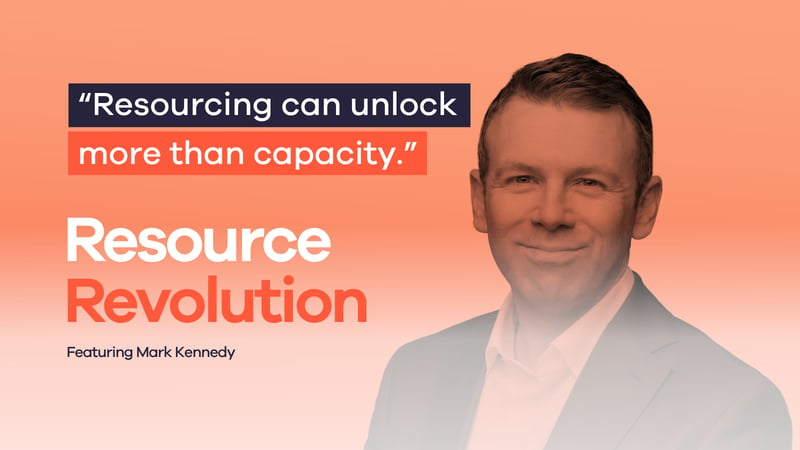
In this episode of Resource Revolution, Mark joins host Christine Robinson to explore what a more agile approach could look like, moving beyond allocation to unlock more than capacity. They discuss how firms can open up opportunity for their people, while preserving the flexibility and human judgment that have long shaped resourcing in tax.
As AI changes how work is delivered and the skills tax professionals need, they also explore what this means for the workforce of the future and how resource management can help firms prepare.
Tune in to the full conversation below or continue reading for Mark’s perspective on the future of resource management in tax.
“How do you keep the magic of that devolved and decentralized model?”
Tax has always been shaped by change. Today, firms are navigating multiple shifts at once.
International tax reform, changes to how work itself is taxed, digitization, sustainability and ESG, and growing transparency and reporting requirements are all creating new demands for tax teams.
“All of those things come together to create demand for what we do, which leads to complexities around how we organize ourselves to respond.” - Mark Kennedy
That question of how to organize is particularly interesting in tax, where the resourcing model has historically looked different from other areas of professional services.
While audit or consulting may involve larger, longer-term engagements with more predictable structures, tax can involve a high volume of smaller, responsive pieces of work alongside predictable compliance activity. Local partners and teams have traditionally managed that through a highly devolved approach, drawing on their knowledge of clients, people, and the work around them.
Mark sees real strengths in that model. At the same time, the environment around it has changed.
“The challenge now is: is that still exactly the right model when we’re working across many more locations, with hybrid working and increased specialization?” - Mark Kennedy
The traditional approach relied on experienced people having strong line of sight across their teams. Maintaining that view becomes harder when people are spread across offices, homes, and countries, and when increasing specialization means skills are less interchangeable.
That human knowledge still has an important role. Knowing a team provides context around sustained overutilization, caring responsibilities, individual circumstances, and the factors that can influence the right resourcing decision.
Mark describes that line of sight as double edged: there are valuable aspects firms will want to preserve, alongside limitations that become more apparent as the workforce evolves.
The next evolution of the model is about extending that human understanding across a larger, more distributed workforce, supported by greater structure and coordination.
“The risk is that opportunity is dictated by your physical location and your direct relationships.”
The relationships behind traditional resourcing can also influence who gets access to work in the first place.
Mark describes how straightforward that could traditionally be:
“The person with the client need would turn to the person sitting next to them and say, ‘Can you help me with this? You worked with me yesterday, I want you to work with me tomorrow.’” - Mark Kennedy
In a hybrid and distributed workforce, that approach can leave talented people outside a leader’s immediate network, out of view.
And established working relationships can reinforce themselves.
“It’s great that people have really close personal relationships and like working together, but that can lead to resource management becoming, ‘I’ve got my team and I’m going to stick with them.’” - Mark Kennedy
For Mark, widening that field of view matters both for the firm and its people. Someone working remotely, someone quieter, or someone less inclined to put themselves forward should still have access to opportunities that help them develop and contribute.
This gives resource management a much broader role in people’s development.
“Resource management for a member of a team should be about being able to plan their career, realize where they have knowledge gaps, and see where opportunity might lie.” - Mark Kennedy
Mark’s own career illustrates that point. The practice he works in today didn’t exist when he started out, and his exposure to new areas came partly through “circumstance and a little bit of luck.” His ambition is for people to have greater ability to see those possibilities and actively drive their careers.
Better resourcing can make opportunity more deliberate, helping firms look beyond established networks for talent and giving individuals a clearer view of where their careers could take them.
“Tax is a world of ever deeper specialization.”
Opening up opportunity becomes even more important as the skills required to deliver the work change.
Tax professionals have traditionally become increasingly specialized as their careers progress. Mark describes how someone can move from being a tax specialist, to a corporate tax specialist, to an expert in a particular subset of corporate tax law.
That depth of knowledge is hugely valuable. Clients also increasingly need professionals who can connect specialist expertise to broader business questions.
“We need to balance the ability to know the right answer because you’re an absolute domain expert with the ability to be broad and think about the bigger question being asked.” - Mark Kennedy
AI could start to shift that balance.
Mark sees the potential for AI to make aspects of specialist knowledge more accessible, giving tax professionals greater scope to apply their expertise across broader questions.
“As certain aspects of domain knowledge become more democratized, it should equip tax professionals to be broader and apply those critical and analytical skills with a tax appreciation.” - Mark Kennedy
That could have significant implications for the shape of the profession.
Mark describes CFOs and heads of tax looking for advisers who can scan the horizon, understand emerging policy developments, model scenarios, and identify what those changes could mean for their business.
“Don’t just tell me about the laws that are here. What are the policy developments that I need to focus on? What does that mean for our business?
- Mark Kennedy
AI could create more space for this work by freeing tax professionals from some of the immediate problems and obligations that consume their time today. Mark sees that as an exciting opportunity for the profession, alongside growing demand for critical thinking, communication with senior business leaders, and confidence in applying new technology.
That changing skills equation has implications for resource management too. The experiences and opportunities people receive today will shape the skills available to the firm tomorrow.
“It should all work symbiotically to help an organization thrive.”
For Mark, mature resource management connects decisions across the individual, project, and firm. For an individual, that means understanding what they’re working on, what’s coming next, and where opportunities exist to gain new experience.
“If I’m not getting exposure in particular areas, can I see demand for the kind of work that I do?” - Mark Kennedy
For someone staffing a project, the view expands to skills, experience, availability, and people’s interest in developing in a particular area.
“You want to be able to see people with the necessary skills and experience. You also want to see people who are really keen to get involved in your area." - Mark Kennedy
At firm level, those decisions add up to a wider picture of the workforce: where demand is growing, where it is leveling out, where peaks and troughs are emerging, and where additional people or investment may be needed.
That broader view allows leaders to look further ahead.
“Do we have a good balance of skills? Are we resilient as a team? Do we have pockets of overreliance on particular people with particular skill sets?" - Mark Kennedy
Technology can help bring those different views together, but Mark is clear that data alone isn’t enough.
“It’s about bringing together the analytics, knowledge of the person, and knowledge of their context, in a way that’s easy to access and use for leaders and team members." - Mark Kennedy
As tax teams become more complex, specialized, and distributed, the role of resource management has to expand with them. A genuinely agile model goes beyond allocating people efficiently. It creates greater fairness in how work and opportunity are distributed, brings better visibility and management of availability, and keeps wellbeing and career development at the heart of resourcing decisions.
It also gives firms a stronger foundation for the future, connecting the decisions made today with longer-term workforce planning and resilience.
And, as Mark puts it, done well, resource management becomes more than an operational function. It becomes a strategic capability that can shape how firms grow, retain their people, and deliver for clients as the demands on tax continue to evolve.

.png?width=500&height=500&name=Untitled%20design%20(79).png)



.png?width=654&height=300&name=Hostguest%20image%20(2).png)
%20(1).png?width=423&height=300&name=Podcast%20Season%203%20Episode%20Banners%20(1068%20x%20591%20px)%20(1).png)