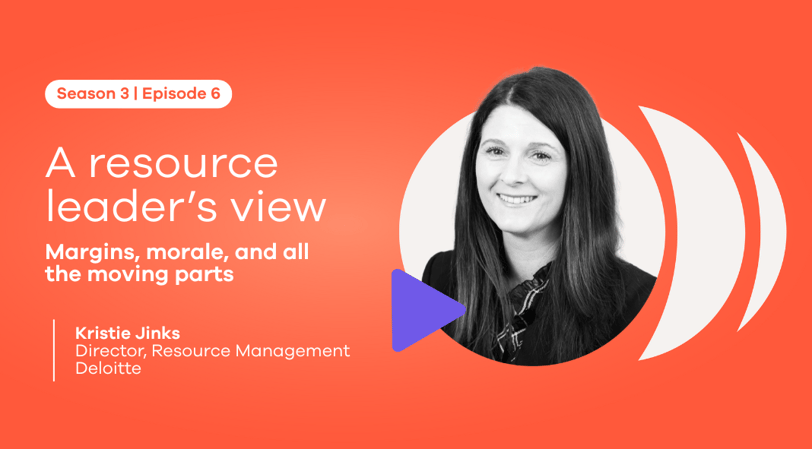
In A resource leader’s view: Margins, morale, and all the moving parts, host Christine Robinson is joined by Kristie Jinks, Director of Audit & Assurance Workforce & Resource Management at Deloitte Australia.
With 25 years’ experience across finance, operations, and client-facing roles, Kristie offers a clear and grounded view of what it really takes to lead in resource management.
Kristie explains why resource management sits in a unique “sweet spot” that supports both margins and morale, and why systemizing decisions at scale is essential when there is so much to track and so much at stake. She also explores the power of resource management as an early warning system, because when there's a cliff ahead – the business needs to know.
Tune in to hear the full conversation or read some of the key talking points below.
“Resource management sits in a sweet spot between people and profit.”
Christine and Kristie open the conversation by exploring why resource management holds such a powerful, often underestimated position in a firm – especially in audit and assurance, where people decisions are commercial decisions. As Kristie explains, the commercial weight of people decisions elevates the function’s strategic importance:
“When you sit in a position where you are looking at the overall cost to deliver a project, and the majority of those costs sit with people, it is really important that resource management has a seat at the table in respect of driving profitability.
Profitability is one thing, but people are just as important – if not more. If you take care of your people, the profitability should come. Resource management is in that perfect position to support both.” - Kristie Jinks
This balance is also why Kristie believes resource management is the connector across the firm. It ties together finance, recruitment, workforce planning, and the day-to-day realities of delivery. From understanding individual strengths and aspirations to balancing utilization, pipeline, and leverage, her team influences both margins and morale every single day.
“If there’s a cliff coming, the business needs to know.”
One of the strongest themes in Kristie’s approach is the idea of resource management as an early warning system, not just tracking what is happening today but predicting what is coming next.
In a Big Four environment, the moving parts are constant: shifting engagement demands, new wins, market changes, offshore capacity, recruitment cycles, and evolving team structures. For Kristie, resource management’s job is not simply to react to this complexity. It's to synthesize it and surface the risks before they hit.
“Even in the short six years that I've been in this role, the increase in its importance and its strategic nature and alignment to business performance has increased exponentially. That impact is helping the business to see what sometimes they can't see well enough in a timely way.
If there’s a cliff coming, we want to be able to advise the business well in advance that there is one – or where there isn’t one and recruitment is more important.” - Kristie Jinks
This kind of visibility only works when resource management is fully integrated with the functions that make the firm run. Finance, recruitment, secondments, surge resourcing, workforce planning, and talent all shape the picture. When these pieces connect, resource management can guide decisions that protect both people and performance.
“Utilization tells a story – and we have to read it early.”
When Kristie talks about profitability, she doesn’t reduce it to numbers – she brings it back to people. For her, utilization is not just a metric. It’s a storyline. A signal. A window into what’s really happening across the firm.
And in a large, complex audit business, that story changes fast.
Christine and Kristie dive into how resource management can uncover risks early by looking beneath the surface of utilization – not just whether people are busy, but whether the right work is being done and whether time is translating into revenue.
“Practitioner utilization is really important because it gives us a view of whether the forecast is reliable. We need to understand hours at risk, where planned chargeability did not follow through, and whether that work translated to revenue.” - Kristie Jinks
Underutilization affects profitability. Overutilization affects morale. And across thousands of practitioners, small signals add up quickly. In Kristie’s view, resource management’s role is to read those signals early:
-
Where are hours at risk?
-
Are we over-relying on certain people?
-
Is the leverage mix right for the engagement?
-
Are changes eroding the original profitability plan?
-
Are we protecting both the bottom line and the individual’s experience?
This is where the data comes to life, when resource management translates it into guidance the business can act on.
“Systemizing what we do is how we stay agile.”
In a Big Four audit environment, complexity is not the exception. It is the norm. Engagement demands shift overnight. New wins land unexpectedly. Teams restructure. And sometimes, in a single week, 100 people need to be staffed on a major project.
For Kristie, the only way to stay ahead of that pace is to systemize what resource management does. Not to create rigidity, but to create the clarity and consistency that make agility possible.
“We make really important decisions all day every day, and it’s so important to have the right system in place to help us know what we need to know, fast. You can win a large contract quickly and need to find 100 people in a week. But you want to make sure you’re finding the right people.” - Kristie Jinks
Systemization is not just process. Technology is essential. With the right tools, teams can translate large datasets quickly, surface risks earlier, and bring sharper insights into conversations with the business. As Kristie notes throughout the episode, measurement is what turns effort into value.
In a function where the to-do list is never fully ticked, clarity and systemization are what make scale possible.
“We make decisions about people’s careers – that’s their life, their livelihood.”
For Kristie, the human impact of resource management is impossible to separate from the commercial one. Every allocation and every opportunity shapes someone’s confidence, development, and long-term trajectory in the firm. Christine and Kristie dig into this people-first dimension.
“We make decisions about people’s careers – that’s their life, their livelihood. That’s what helps them get to their next career aspiration or gain a skill they didn’t have before.” - Kristie Jinks
Resource management is at its best when it understands individual strengths, aspirations, and workload realities, and turns that into meaningful development opportunities at scale.
This is also what drives client outcomes.
“People-led decisions drive great outcomes for the firm. Clients keep coming back because we can put our best people forward into those roles.” - Kristie Jinks
For Kristie, that impact is the reward: helping people feel good about what they are doing and where they are going – and knowing that when people thrive, clients feel the difference.
“Don’t go it alone – consult, influence, and bring people with you.”
One of Kristie’s core lessons for anyone wanting to grow in resource management is this: you cannot operate in isolation. Resource management is a stakeholder-heavy role, and success depends on the strength of the relationships you build.
“Don’t go it alone. Always consult. What the business wants is more important than what you want – and when you bring it together through consultation, you get to the right outcome faster.” - Kristie Jinks
For Kristie, this means shaping conversations with data, framing the “so what,” and being brave enough to have difficult conversations early, before issues grow.
“Do not pretend to know what you do not know. Get in the room. Ask the questions. Start somewhere. Influence from a place of clarity and honesty. And when things do go wrong? Own it. Be brave enough to go back in and say sorry when sorry is due. If you’re genuine and you own it, people will help you.” - Kristie Jinks
In Kristie’s view, resource management leaders are translators, connectors, and horizon-watchers. They balance commercial needs with human ones, stay close to the signals that matter, and guide the business through the twists in the road to keep margins and morale moving in the right direction.
And if there’s one underlying message for resource leaders, it’s this:
“You have to drive the why – you have to remind people why resource management exists, and its true power.” - Kristie Jinks
Catch the full episode for more insights and strategies for leading in resource management.

.png?width=500&height=500&name=Untitled%20design%20(79).png)




%20(1).png?width=423&height=300&name=Podcast%20Season%203%20Episode%20Banners%20(1068%20x%20591%20px)%20(1).png)