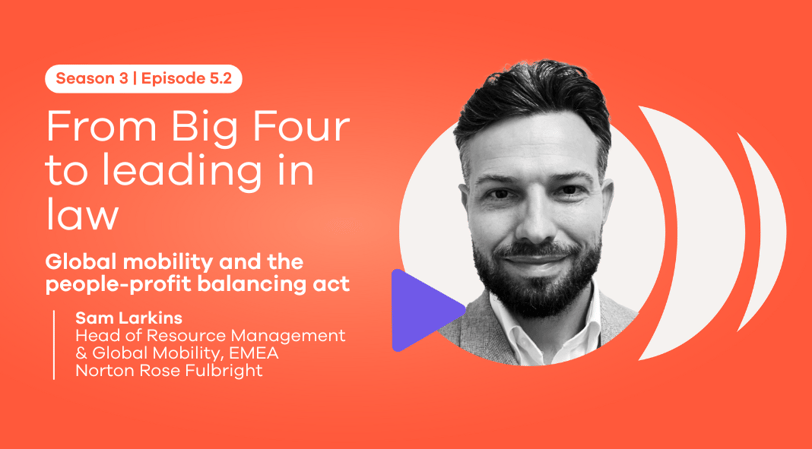
In From Big Four to leading in law, host Christine Robinson speaks with Sam Larkins, Head of Resource Management and Global Mobility, EMEA, at Norton Rose Fulbright – a leading global law firm.
Sam traces his journey from starting out as a resourcing officer at PwC to leading two interconnected functions across an international practice. His experience spans the commercial, operational, and human sides of the role – from global mobility to embedding wellbeing into workforce decisions.
The conversation touches on balancing commercial priorities with the needs of your people, staying open to new opportunities, and why the future of resource management will demand a new kind of leader.
Tune in to hear the full conversation or read some of the key talking points below.
"The key word for me is... adaptability.”
Christine and Sam begin by exploring his journey from PwC to a leading global law firm – a career shaped by lateral moves, sector shifts, and the willingness to step into unfamiliar environments. At PwC, Sam built his foundation in a mature, highly structured resource management function. But moving into consulting, Big Tech, and eventually legal gave him something deeper: adaptability.
For Sam, these transitions weren’t accidental. They were deliberate career accelerators – each exposing him to new leadership styles, ways of working, and business models. And moving into the legal sector – where resource management is still developing – required him to unlearn old assumptions and rebuild processes from the ground up.
“Resource management as a profession is done very differently in different organizations. Even if the teams look the same on paper, they actually operate really differently – different leaders, different finance teams, different ways of working.
Gaining a variety of experience is only going to make you a better, more well-rounded resource management professional, so my advice is to seek opportunities to do that. Think about the types of projects you could work on that are broader than resource management.
The key word for me around lateral moves is adaptability.
Coming into the legal industry, I had to unlearn the expectation that the process would work the same way it did in previous firms. It’s still maturing here, and not everything comes through resource management – so you have to track what you’re doing and use the data to show the value.” - Sam Larkins
"There's real synergies between global mobility and resource management.”
Sam then shares how taking on global mobility alongside resource management opened up a new dimension to his role. Rather than treating global mobility as a separate HR process, he’s brought the two areas together – using international assignments and structured swap programs to unlock talent across locations and enrich people’s careers.
For Sam, this combination isn’t an anomaly, but an opportunity for firms to think differently about how they match skills, markets, and mobility.
“It was a great opportunity for me to take on a new and different area, and I could really see the synergies between global mobility and resource management. When we’re staffing projects, we’re obviously looking for talent internally, but sometimes there might be talent in a different location.
Rather than using them on an ad hoc basis, it’s an opportunity to find skills and then second people over on an assignment – short term, long term, or a permanent transfer. This has allowed us to unlock capability from different locations.
We’ve just launched a swap program between Asia and Australia, and once they land, it’s part of RM’s responsibility to help get them utilized quickly and embedded into their new team.” - Sam Larkins
“Resource managers are at the heart of daily wellbeing conversations.”
The discussion turns to wellbeing – an area Sam believes is inseparable from effective resource management. Because RM sits at the intersection of work allocation and people’s lived experience, resource managers are often the first to hear when someone is stretched, struggling, or heading toward burnout.
Sam explains how his team uses both data and conversation – supported by mental health first-aid training – to spot issues early and act with care.
"Resource managers tend to be the first port of call when somebody wants to talk about their workload. People will give you a reason why they can or can’t take on more work – and might say, ‘I’m really struggling, I can’t take on any more.’ Resource managers are at the heart of those conversations on a daily, daily basis. That’s where I think we, as a profession, play a really important role in spotting those early warning signs.
We track high utilization as well, so we can be more preventative. If someone has been over 100% utilized for three or four weeks in a row, that’s when the resource manager plays a critical role in checking in with that individual – understanding what’s going on in their world and whether they need to ramp down a bit on the next project.
We take a preventative approach through the data, but the power is in the conversation we have with individuals.” - Sam Larkins
“It’s a win–win for the business and a win–win for the individual."
Christine and Sam discuss how effective resource management protects the bottom line, reduces recruitment costs, and gives leaders more time to focus on clients. Sam describes the day-to-day work of breaking down silos, challenging default “we need to hire” thinking, and creatively combining capacity across teams to meet demand.
For him, this isn’t just about efficiency. It’s about creating opportunities for people while making smarter use of the firm’s existing talent.
“To protect the bottom line, resource management can save on recruitment costs. We see this time and time again where there are siloed behaviors – people want to recruit because they don’t think they’ve got the right individual.
But if you use the resource management team, we can break down those silos. We can say, ‘I know you were looking for 100% of this individual – what I can find is 75% of an individual here and 25% of an individual over there.’ And we can use our ability to influence to say, ‘Why don’t you take a shot on this person from a different team?’
It saves a huge amount of cost in recruitment and it also develops the capabilities and skills of individuals through that lateral experience. It’s a win–win for the business and a win–win for the individual.” - Sam Larkins
“AI is where we'll see real scale.”
Looking ahead, Sam reflects on how rapidly technology – and especially AI – is reshaping the resourcing landscape. For him, this shift is already here. Resource management teams are beginning to feel the impact as manual searching, repetitive data work, and time-consuming matching tasks become increasingly automated.
Sam explains that the real opportunity lies in freeing resource managers from the heavy administrative lift so they can focus on higher-value work: interpreting insights, having meaningful conversations, and advising the business.
“AI is everywhere at the moment and that is where you’ll see real scale in resource management. It will take out a lot of the manual searching and manually looking at the data. A lot of that should be stripped out to leave more time for impactful conversations – analyzing the data, not running the data.
There’s AI tech out there giving you the percentage match for people in the click of a button that would take hours to do yourself. So that's only going to further scale even quicker than we've seen in the last 10 years.” - Sam Larkins
Alongside the rise of AI, Sam highlights the importance of staying open-minded to emerging technology and connected to the resource management community to keep pace with what’s coming.
“The technology landscape will be changing vastly over the next five to ten years. It’s really valuable to have an open mind about the technology you’re using in resource management and to look at what is changing.
Going to resource management events gives you an idea of the technology that’s changing, how it could adapt to your firm, and what other people are doing in terms of their challenges and ideas. I’ve gained a broad network in resource management and these events just broaden that further.” - Sam Larkins
“Don’t wait for change to come to you.”
His closing advice to listeners is: don’t be passive, because the next generation of resource management leaders will need to actively step into the change ahead.
“The best career advice I’ve had is to be at the forefront of change and don’t wait for change to come to you – and I think that's never been as important as it is in resource management right now.” - Sam Larkins
Catch the full episode for more career insights and resource management reflections from Sam.

.png?width=500&height=500&name=Untitled%20design%20(79).png)