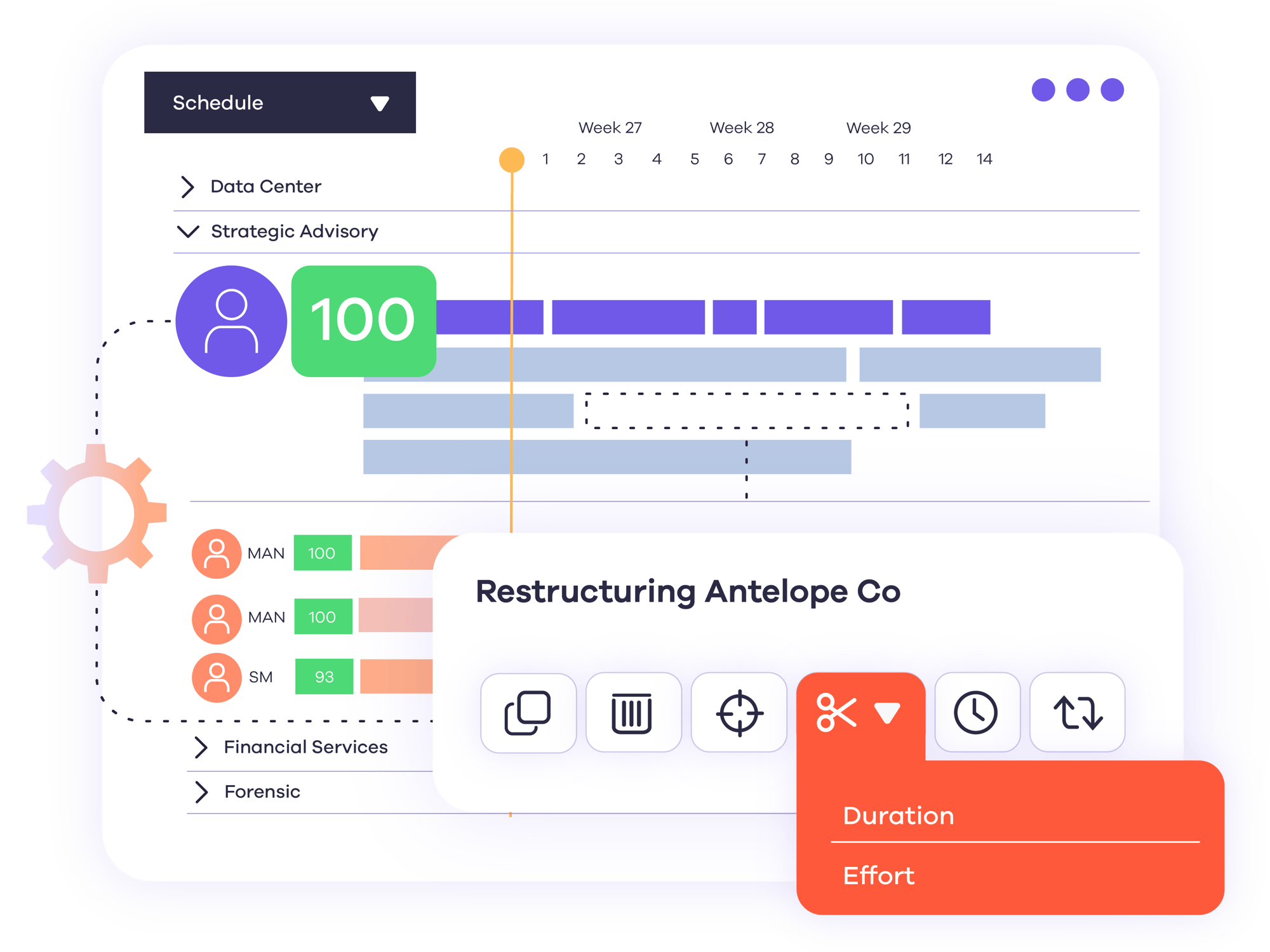
An organization’s resource management, and its maturity, is an often overlooked function that plays a pivotal role in achieving this goal. In this blog, we explore what true resource management maturity looks like, examine the different stages of resource maturity, and look at how to optimize your firm’s current level.
Key takeaways
-
Resource management maturity is a measure of how well optimized a firm’s resource management function is
-
The benefits of achieving a high level of resource maturity include enhanced resource scheduling, optimal resource utilization, improved staff retention, sustainable growth, and the ability to make more strategic decisions
-
The resource management maturity model provides a framework for assessing resource maturity. Stage 5 is the most strategic, proactive, and centralized and level, with AI and automation embedded in processes. In contrast, stage 1 is reactive, decentralized manual, and spreadsheet-based
-
Optimizing resource maturity requires buy-in from stakeholders at all levels, a change impact assessment, and a detailed project plan
Contents
-
What is resource management maturity?
-
How to assess your organization’s resource maturity
-
The resource management maturity model
-
How to optimize your firm’s resource management maturity
-
Case study: enhancing resource management maturity
-
Take the first step in your resource management maturity journey with Dayshape
What is resource management maturity?
Resource management maturity, or resource maturity, is a measure of how advanced and optimized a firm’s resource management processes are. There are different stages of resource management maturity, with lower levels of maturity taking a more reactive approach defined by siloes and manual processes. In contrast, mature resource management is proactive, strategic, and centralized, with resources shared across service lines, offices, and geographies.
Improving, or maturing, your firm’s resource management function is imperative to ensure it is making the most of its most valuable asset - its people. This is because effective resource allocation and utilization significantly impacts efficiency, profitability, and client and employee satisfaction.
How to assess your organization’s resource maturity
In order to advance your firm’s resource maturity level effectively, you need to understand where it’s currently positioned. To assess your organization’s resource management maturity, consider the following:
-
What technology do you use to manage resource? Do you rely on traditional spreadsheets, dedicated software, or an automated system that incorporates the latest AI?
-
How do you currently manage resource scheduling? Do you follow a reactive approach or use a centralized system? Are you using automation?
-
How formal are your existing resource management processes? Do you have these? Are they siloed, or firm-wide and strategic?
-
How is skills information managed across your firm? Do you use spreadsheets or a centralized database? How often is this updated?
-
How do you currently report on resource utilization? Is this a manual process, or is automation involved? Is data collected in real time or retrospectively
Truly mature resource management will be strategic, firm-wide, and centralized, embracing AI and automation. Take our interactive resource management maturity quiz to assess your firm’s current resource maturity level.
The resource management maturity model
The resource management maturity model is a framework that firms can use to assess how mature their current resource management processes are. It comprises five stages:
-
Reactive
-
Foundational
-
Formalized
-
Centralized
-
Strategic
The higher the number, the more mature your firm’s resource management is.
The 5 stages of resource management maturity
Let’s take a look at each of the resource management maturity stages in turn, starting with stage 5, which firms should be striving to achieve.
Stage 5: Strategic
The highest level of resource maturity is strategic, with resource management adopting a centralized, firm-wide approach that’s aligned with wider organizational goals. Companies with the most mature approach to resource management will embrace AI and automation to manage resource in real time.
Key features:
-
Strategic
-
Firm-wide
-
Automated
-
Centralized
Stage 4: Centralized
Firms at this resource maturity stage may experiment with AI and automation, but they’ll primarily take a consistent approach to resource management, ensuring all processes are documented and monitored to support compliance.
Key features:
-
Proactive
-
Centralized
-
Consistent
Stage 3: Formalized
This is a common stage of resource management maturity for many firms; there might be some attempt to optimize maturity, but processes will be inconsistent, impacting overall efficiency. For example, some processes are likely to feel clunky, and there may be software integration issues.
Key features:
Stage 2: Foundational
At this resource maturity level, there will be some resource management processes in place, but these are unlikely to be delivering the desired results. This makes resource under- and overutilization more of a risk, impacting everything from staff retention to profitability.
Key features:
Stage 1: Reactive
Reactive resource management is not mature at all, and is usually inefficient, clunky, and leads to more problems than solutions. Significant optimization is required at this stage.
Key features:
-
Admin-intensive
-
No skills database
-
Spreadsheet-based
-
No reporting
How to optimize your firm’s resource management maturity
Optimizing resource management is essential for professional services firms looking to improve efficiency, profitability, and employee satisfaction. As your firm matures its resource management function, you gain greater visibility into resource allocation, enhance engagement performance, and create a more balanced work environment. But how do you get there? Follow the steps below:
1. Know your goals
Take the time to think about what your firm’s resource management goals are. What will resource maturity look like to your business? Consider the barriers that may prevent this, and how you’ll be able to mitigate these.
Set out who will be responsible for maturing resource management processes, and establish a timeline.
2. Assess current resource maturity perceptions
Consider current perceptions of your firm’s current resource management function across the organization. Some people will simply view it as ‘scheduling’, and won’t be aware of the strategic impact it can have. Tackle these misconceptions, and think about the language used to describe the function internally; some firms use ‘talent alignment’ or ‘talent experience management’ as an alternative to ‘resource management’.
3. Change impact assessment
A change impact assessment is necessary for any type of business transformation. This will be referred to throughout the resource management optimization process, and should clearly set out the departments, roles, and processes that will be impacted by the change, and how.
4. Secure buy-in from stakeholders
Present your business case for resource maturity optimization to key stakeholders to secure buy-in at all levels. Ask them about the perceived benefits and blockers from their perspective too, and work on a plan together that shows how each of these will be navigated.
5. Create a project plan
The next step is to devise a plan for improving resource management maturity. What this looks like will depend on your firm’s current resource maturity stage. Create a clear timeline that states:
6. Monitor key metrics
Benchmark and monitor key metrics throughout the resource maturity optimization process. The most important metrics will vary from firm to firm, but common KPIs to track include resource utilization uplift, increased productivity, and higher profitability.
Case study: enhancing resource management maturity
Wolf & Company approached Dayshape as the accounting and advisory firm wanted to mature its resource management function.
After choosing Dayshape, Wolf & Co. successfully enhanced its resource maturity by improving engagement planning, significantly improving its reporting function, and prioritizing skills-based scheduling.
Kristiann Phelan, RMCP Resource Manager and Amanda Matczynski, Director of Data Services at Wolf & Company, commented: “Before, we had no idea who was working on what, and what capacity everyone had. We’d send manual emails around the teams to ask who had availability when new work came in. Having that visibility of everyone’s schedules, rather than having to search around in a spreadsheet is a big win.”
Take the first step in your resource management maturity journey with Dayshape
Enhancing your organization’s resource management will boost your firm's efficiency, performance, and profitability. Improving your resource management function empowers your firm to enhance decision-making, minimize risks, and optimize growth.
Dayshape’s AI-powered resource management platform is designed to support and empower true resource management maturity. Centralize resource management, use AI-powered scheduling, harness real-time data, and automate reporting.
Book a demo today, or contact us to find out more.
Based on an article originally featured in AIT.




.png?width=500&height=500&name=Untitled%20design%20(79).png)

.png?width=423&height=300&name=From%20scheduling%20to%20strategy%20(2).png)