In this episode of Resource Revolution, the focus is on the power of community – and why the strongest resource leaders never lead alone.
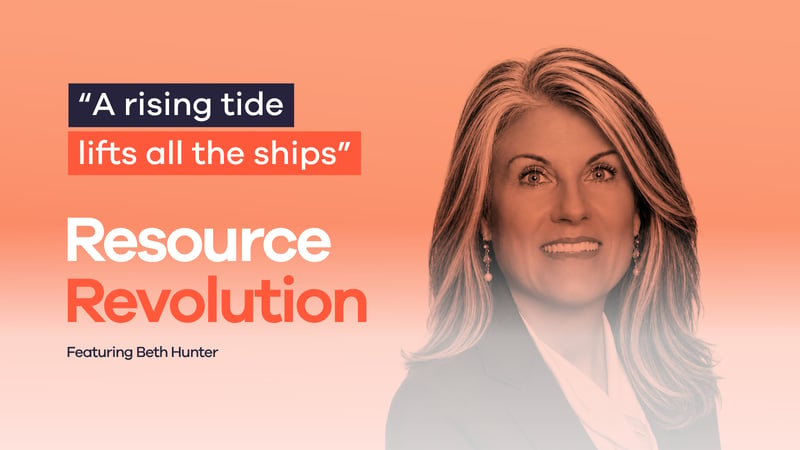
Host Christine Robinson is joined by Beth Hunter, Resource Experience Management Leader at Rehmann and Vice President of The Resource Management Executive Forum (RMEF). As a founding member of the RMEF, Beth has helped build a trusted community where senior resource management leaders can share ideas, tackle common challenges, and learn from one another.
Reflecting on the latest RMEF, Beth explores the conversations shaping resource management today, from AI and workforce strategy to operational maturity and the challenge of managing ambiguity. She also shares her perspective on building resource management functions that can scale and why learning from leaders outside your own organization can make everyone stronger.
Whether you're leading a resource management function, navigating the next stage of its maturity, or looking for new perspectives on the challenges facing the profession, this conversation is a reminder that you don't need to have all the answers yourself. You just need to know where to find them.
Tune in to the full conversation below or continue reading for Beth's insights on leadership, shared learning, and why a rising tide lifts all ships.
“A rising tide lifts all ships.”
What happens when resource management leaders from different firms start comparing notes?
That question sits at the heart of The Resource Management Executive Forum.
The latest RMEF Leadership Roundtable brought together resource management leaders from firms of different sizes and maturity levels, alongside COOs, CFOs, CHROs, practice leaders, and other senior executives. The conversations covered everything from AI and offshore talent to tax, value-based pricing, and the wider transformation taking place across professional services.
But one of Beth’s biggest takeaways was how much firms can learn from one another.
“I need people that I can bounce things off of in a safe space, where I can hear your perspective. We’re smarter together.” - Beth Hunter
That perspective becomes particularly valuable at leadership level. Resource management leaders may have strong teams and trusted colleagues within their own firms, but there are some challenges that only someone doing the same job in another organization will fully understand.
Despite differences in size, structure, and strategy, many leaders are grappling with the same questions. What differs is how they’re approaching them, what they’ve already tried, and what they’ve learned along the way.
And Beth is clear that sharing those experiences isn’t about giving away competitive advantage. It’s about raising the standard of resource management across the industry. If one firm finds a better way to tackle a challenge others are facing too, there’s value in learning from it rather than solving the same problem in isolation.
“It’s not checkers. It’s chess.”
Ask a resource manager what the hardest part of the job is and the answer might sound deceptively simple: finding the right person.
But as Beth explains, the ability to make that match rarely comes down to the information available in that moment.
“Your ability to find that person doesn't start in conversations today. It's 18 months ago. You have to balance the interns, the promotions, and the attrition... All of the things lead you to this question today.” - Beth Hunter
The decision being made today is shaped by months of workforce planning: promotions, attrition, project rollovers, governance, and decisions made across different practices.
And the consequences extend just as far.
Who gets staffed affects an individual’s career trajectory, how an engagement performs, the experience of the client, the confidence of the leadership team, and ultimately firm profitability.
“There’s so much at stake. It’s the career trajectory of that practitioner, how the engagement is going to run, how happy the client will be, and how much money the firm is going to make.” - Beth Hunter
That complexity is also why Beth sees managing ambiguity as such an important capability in resource management. There isn’t always a perfect answer. Resource managers are balancing a chain of interconnected decisions, often with incomplete information and competing priorities, and the further ahead they’re planning, the more variables there are to contend with.
As Beth puts it: “It’s not checkers. It’s chess.”
“Control what you can control.”
As resource management functions mature, so does the question of how their performance should be measured.
Beth makes an important distinction between the outcomes resource management can influence and those it can genuinely own.
Utilization is a good example. Resource managers can help put the right people in the right places, but they don’t control every factor that ultimately determines whether utilization lands above or below target.
So Beth looks closely at something her team can own: forecast accuracy.
“We’re not measured on whether you get to 80% utilization, but how close you are to what we said you were going to be. Your forecast accuracy is directly related to your data practices.” - Beth Hunter
It shifts the measure of success from an outcome the team can only partly influence to the accuracy of the insight it provides.
The question becomes less about whether resource management delivered a particular utilization number and more about whether the business had a reliable view of what was coming.
And that takes more than forecasting. Beth connects accuracy back to the discipline behind it: whether schedules are kept up to date, whether data is accurate, and whether the team is consistently looking far enough ahead to account for changes in the workforce, market, and firm strategy.
The more reliable that view becomes, the more useful resource management becomes as a forward-looking business function.
“Work from a position of peace, not fear.”
AI featured heavily at the latest RMEF Leadership Roundtable, but Beth’s biggest takeaway wasn’t about a particular technology or use case.
It was about how leaders choose to approach the change.
One idea from the discussion particularly resonated with her: AI isn’t going to replace accountants, but accountants who use AI will perform better than those who don’t.
Beth puts that into the context of technological progress more broadly, comparing AI with earlier innovations, from the washing machine to the wheel, that didn’t remove the need for people but expanded what they were able to do.
“Technology makes us smarter... When we look back in however many years advancements in AI will take us, we will see then that this made us better as well.” - Beth Hunter
That perspective has changed how Beth approaches the uncertainty surrounding AI.
“I can work better from a position of peace than from a position of fear.” - Beth Hunter
At a time when resource management leaders are navigating AI, new workforce models, changing economics, and increasingly complex decisions, no one leader is going to have every answer.
And they don't need to.
Having trusted peers to test ideas with, learn from, and challenge your thinking can make the difference between solving every problem from scratch and building on what others have learned.
As Beth puts it: “We’re smarter together.”

.png?width=500&height=500&name=Untitled%20design%20(79).png)