Request a Dayshape demo
Get in touch and learn first-hand how Dayshape can help boost profitability, improve client service, and keep your teams happy.

Platform
Optimize margins. Grow revenue.
Plan reliably. Act confidently.
Inspire teams. Delight clients.
Enterprise scalability
Use Cases
By role
10 ways for resource managers to elevate their impact
Elevate your role, expand your influence, and drive impact across your firm.
Listen nowCustomer Success
Company
Resources
Resources
Featured resources
Professional services: Navigating a new operating era
.png?width=500&height=500&name=Untitled%20design%20(79).png)
Leadership perspectives on building the next generation operating model for the AI era, drawn from a 2026 survey of 400 senior leaders across mid-to-enterprise professional services firms in the UK and US.
Read the reportNew research from 400 C-suite and senior leaders across the UK and US examining how the world's most complex professional services firms are rethinking growth, and why the operating model has become the new source of competitive advantage.

%20(1).png?width=1200&height=627&name=Internship%20blog%20(1200%20x%20627%20px)%20(1).png)
For the first time, professional services firms are no longer creating value through people alone.
For decades, growth followed a familiar formula: win more work, hire more people, deliver more work. Today, firms are building delivery capability in fundamentally different ways, combining people, AI, and global delivery, breaking the traditional link between headcount and growth.
But creating new sources of capacity is only part of the equation. Performance will increasingly depend not on creating more capacity, but on coordinating every source of capacity more intelligently.
At the same time, firms face growing pressure to deliver profitable growth, demonstrate returns on AI investment, adapt to evolving pricing models and governance requirements, and meet ever-rising client expectations. Together, these forces are making the operating model itself a source of competitive advantage.
Last year, Dayshape’s report, Inside the leadership growth agenda explored the visibility challenge limiting growth across professional services, highlighting how operational blind spots contributed to revenue leakage, weaker financial performance, and missed opportunities.
This year’s research shows that the conversation has moved on. Visibility is no longer the destination. It’s the starting point.
The firms creating a competitive advantage are moving beyond visibility toward a more connected operating model, capable of coordinating people, AI, and global delivery as one.
As the definition of a resource expands to include AI alongside people, so too must the discipline responsible for optimizing how it is deployed. That is why resource management is becoming one of the defining strategic capabilities of the next operating era.
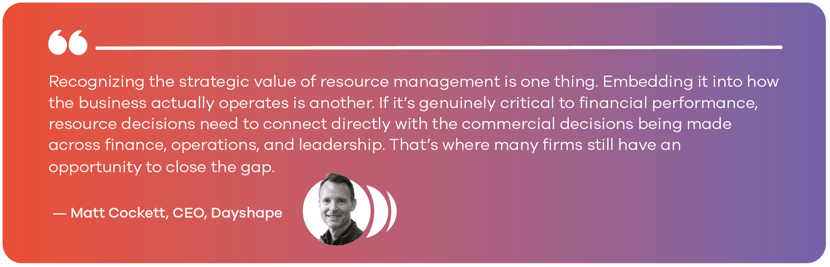
For me, that is the opportunity. Professional services has always evolved alongside technology. But this time it is different. Firms have the opportunity to rethink not just how work is delivered, but how growth itself is created through an entirely new workforce model.
The firms that do that successfully will define the next operating era of professional services. I hope this research provides both the insight and the inspiration to help your firm lead it.

— Matt Cockett, CEO, Dayshape
For professional services firms, growth has always meant scale. Across Audit, Tax, Consulting, Deals, Risk, and Managed Services alike, the familiar formula is to win more work, hire more people, and bill more hours. But that model is changing.
AI is reshaping how work is delivered, while global delivery models are expanding how firms access and deploy talent across onshore, offshore, and nearshore teams. Firms are building delivery capability through an increasingly diverse mix of people, AI, and global delivery.
The upside is real, but so is the complexity. Coordinating thousands of professionals, a growing bench of AI capabilities, and delivery centers spanning multiple geographies and service lines is a far harder problem than coordinating a single office or practice. Competitive advantage increasingly depends on how effectively firms coordinate people, AI, and global delivery through one connected operating model.
Drawing on insights from 400 C-suite and senior leaders at professional services firms with 750+ employees across the UK and US, this research explores how firms are adapting, and what capabilities separate those forging ahead from those still building the foundations.
At a glance
Big Four firms are investing heavily in AI, global delivery, and workforce transformation. Yet our research reveals a growing gap between strategic ambition and operational execution.
AI adoption and strategic conviction are outpacing operational readiness.
Nearly four in five firms use AI to deliver client work, and almost every senior leader recognizes the importance of resource management to financial performance. 93% are also confident in their workforce forecasting.
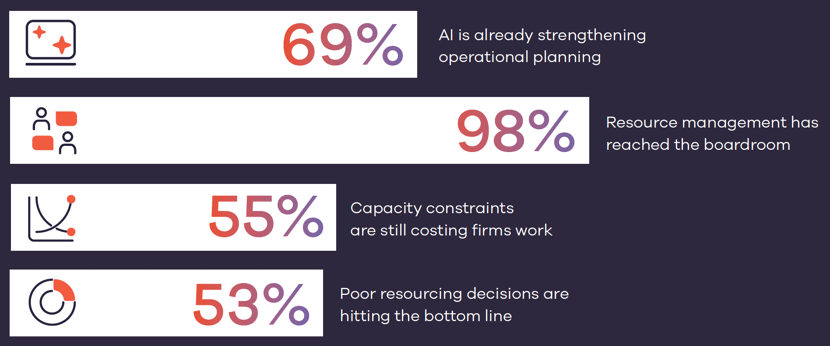
Yet only 14% of firms have embedded AI across all resource operations, and over half still miss, delay, or turn down work due to capacity constraints.
Four key findings show how that tension, which is further amplified by scale, is playing out across the industry:
1. The priorities behind growth are changing.
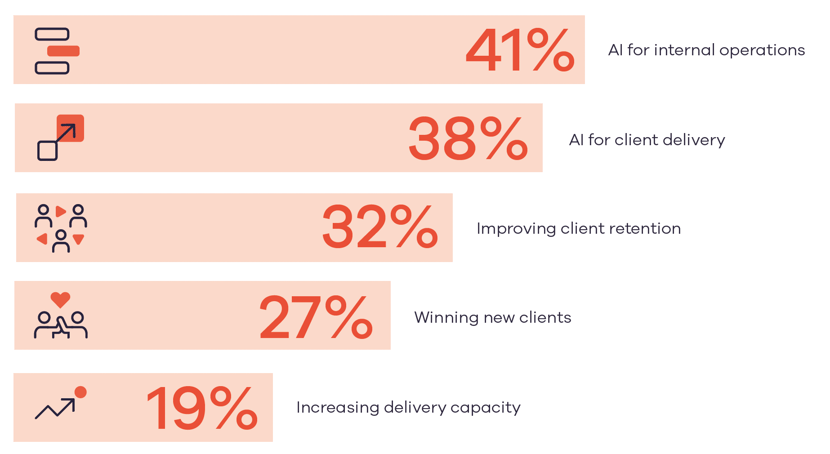
AI now tops the industry's strategic agenda, with 41% of firms prioritizing AI for internal operations and 38% prioritizing AI for client delivery. Client retention (32%) also ranks ahead of winning new clients (27%), while increasing delivery capacity (19%) sits lower on the leadership agenda.
For firms operating across multiple service lines and geographies, that puts greater emphasis on coordinating capacity across people, AI, and global delivery to support increasingly integrated client engagements.
2. AI adoption is widespread. Operational maturity is not.
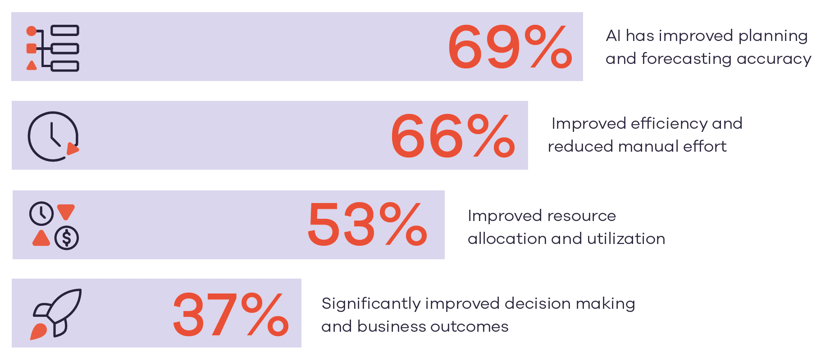
79% of firms already use AI to deliver client work, with 69% reporting improved planning and forecasting accuracy and 66% improved efficiency and reduced manual effort.
Yet only 16% use AI-supported demand forecasting and 14% have embedded AI across all resource operations. There’s considerable scope to extend AI into how capacity is forecast, allocated, and reallocated as demand changes.
3. Resource management is now a leadership priority.
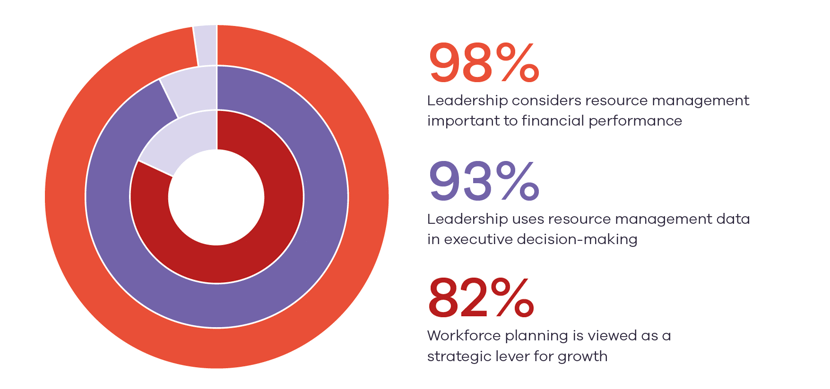
98% of senior leaders recognize the importance of resource management to financial performance, 93% use resource management data in executive decision-making, and 82% view workforce planning as a strategic lever for growth.
4. Strategic recognition has outpaced operational execution.
Despite that recognition, 55% of firms still miss, delay, or turn down client work because of capacity constraints, while 53% say poor resourcing decisions regularly reduce project margin.
Looking ahead.
The next challenge for large professional services firms isn’t just to create more capacity or see where it sits. It’s coordinating capacity across people, AI, and global delivery amid changing demand and commercial priorities.
Throughout this report, we explore what that progression looks like, and why capacity intelligence is becoming a defining capability of the next operating era.
Visibility creates awareness. Capacity intelligence turns that understanding into better decisions.
The signals are everywhere. Chief AI Officer and equivalent executive roles are emerging across many of the world’s largest professional services firms. AI strategy is no longer confined to innovation teams. It has become a C-suite priority.
Yet for all the attention surrounding AI, the reality appears far more nuanced.
Some firms are already embedding AI into delivery and building more connected operating models. Others are still working to coordinate more complex global delivery models, strengthen workforce planning, improve data quality, and establish the foundations needed for AI to deliver meaningful business value. AI is less forgiving of weaknesses in data and processes that human teams may have worked around for decades, making previously hidden inefficiencies more apparent in both the quality and cost of AI-enabled delivery.
As a result, operational maturity is uneven, not only between firms but across functions and departments within them.
Dayshape’s 2025 Inside the leadership growth agenda report explored the internal barriers limiting growth across professional services. It showed how weaknesses in planning, forecasting, resource management, and operational visibility were quietly contributing to revenue leakage, weaker financial performance, and missed opportunities. The report concluded that predictable growth depended on stronger planning, forecasting, resource management, and the operational visibility needed to support better decisions.
This visibility remains fundamental. But the real challenge is what firms do with it.
The next operating era demands more than a clearer view of capacity. It requires the mechanisms to coordinate that capacity, orchestrate delivery, and maintain control across people, AI, and global delivery.
For firms operating at the scale of the Big Four — spanning dozens of markets, thousands of client engagements, and delivery models that combine onshore teams, global capability centers, and a rapidly expanding set of AI tools — the coordination challenge is exponentially more complex. Managing that complexity isn't just an operational question. It's a strategic and commercial one.
This report examines what that means for organizations spanning Audit, Tax, Consulting, Deals, Risk, and Managed Services, and the capabilities that will define operational maturity in this new environment.
This shift is visible in leadership priorities
AI now tops the strategic agenda, improving client retention ranks ahead of winning new clients, while increasing delivery capacity sits much lower.
Strategic priorities for the next 12 months
Strategic priorities: Then → Now
Comparing findings from Dayshape's 2025 Inside the leadership growth agenda research with this year's survey.
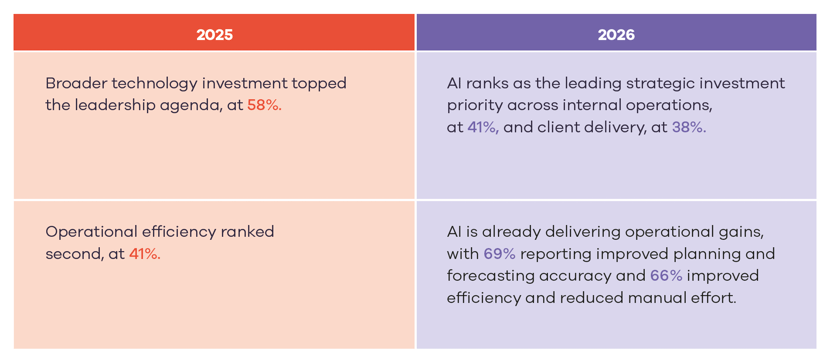
The priorities behind growth have become more targeted.
Last year’s research showed technology investment as a broad strategic priority. This year, that focus has become more specific, with leaders prioritizing where AI can create value across both operations and client delivery.
Growth priorities are shifting too. Improving client retention now ranks ahead of winning new clients, while increasing delivery capacity sits at the bottom of the priorities measured.
Rather than signaling a retreat from growth, the findings point to a change in how firms are pursuing it. Instead of relying on proportional increases in headcount, firms are placing greater emphasis on tech, productivity, and getting more value from existing client relationships and capacity.
This reflects a broader shift across professional services. Deloitte’s latest State of AI in the Enterprise research similarly points to organizations moving beyond broad AI adoption toward measurable business outcomes. AI investment is increasingly being judged by the business performance it can create, rather than adoption alone.
One detail in the data is particularly interesting: firms place slightly greater emphasis on AI for internal operations (41%) than client delivery (38%).
The difference is modest, but it reinforces an important point. AI investment is not only focused on changing the services firms deliver. It is also being directed toward how the business itself operates, from planning and forecasting to the decisions that shape delivery.
Growth constraints: Then → Now
While leadership priorities are evolving, several of the barriers limiting growth remain familiar.
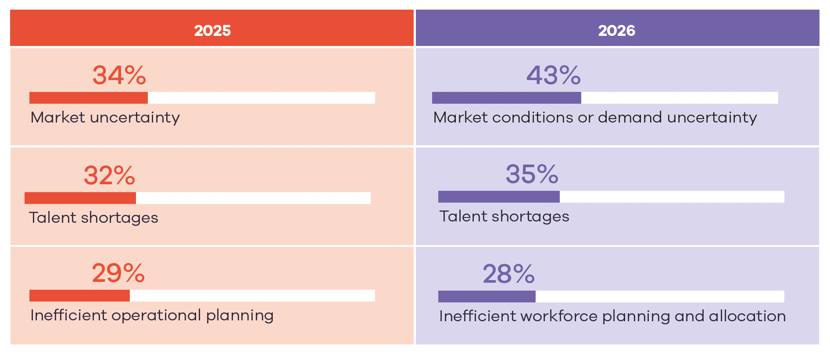
Operational capability is becoming just as important as workforce capacity.
External market pressures remain the biggest constraints on growth. But technology limitations (34%) now rank alongside talent shortages (35%), while inefficient workforce planning and allocation (28%) remain among the largest controllable barriers.
This matters because these are the same operational capabilities firms are now looking to strengthen through AI.
The opportunity is not simply to invest in new technology, but to use it to improve how firms plan, allocate, and deploy a more complex mix of capacity.
The economics of growth may be changing, but the fundamentals remain: firms still need the right capacity, in the right place, at the right time. The difference is that capacity is no longer defined by headcount alone.
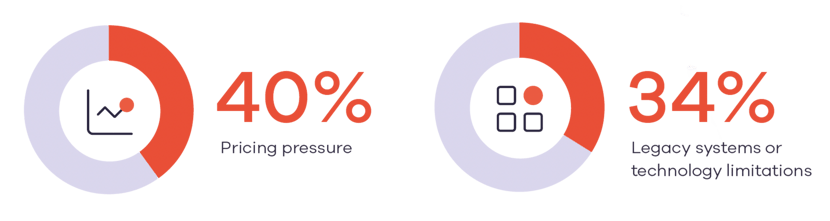
Emerging pressures in 2026
Where organizations are realizing the greatest value from AI
Operational impact: Then → Now
Comparison of findings from Dayshape's 2025 Inside the leadership growth agenda and this year's survey.
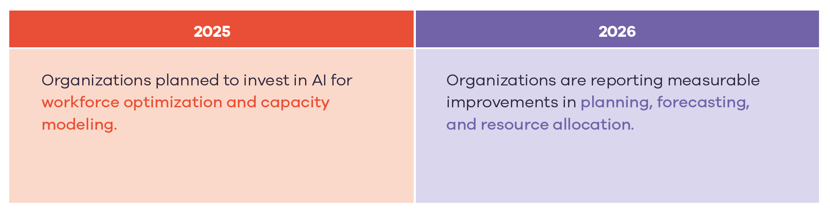
A year on, firms are beginning to report the operational impact.
Last year’s research showed firms preparing to use AI to strengthen workforce planning and capacity management. This year’s findings show that investment is beginning to translate into measurable improvements.
AI adoption is widespread. Operational maturity is still developing.
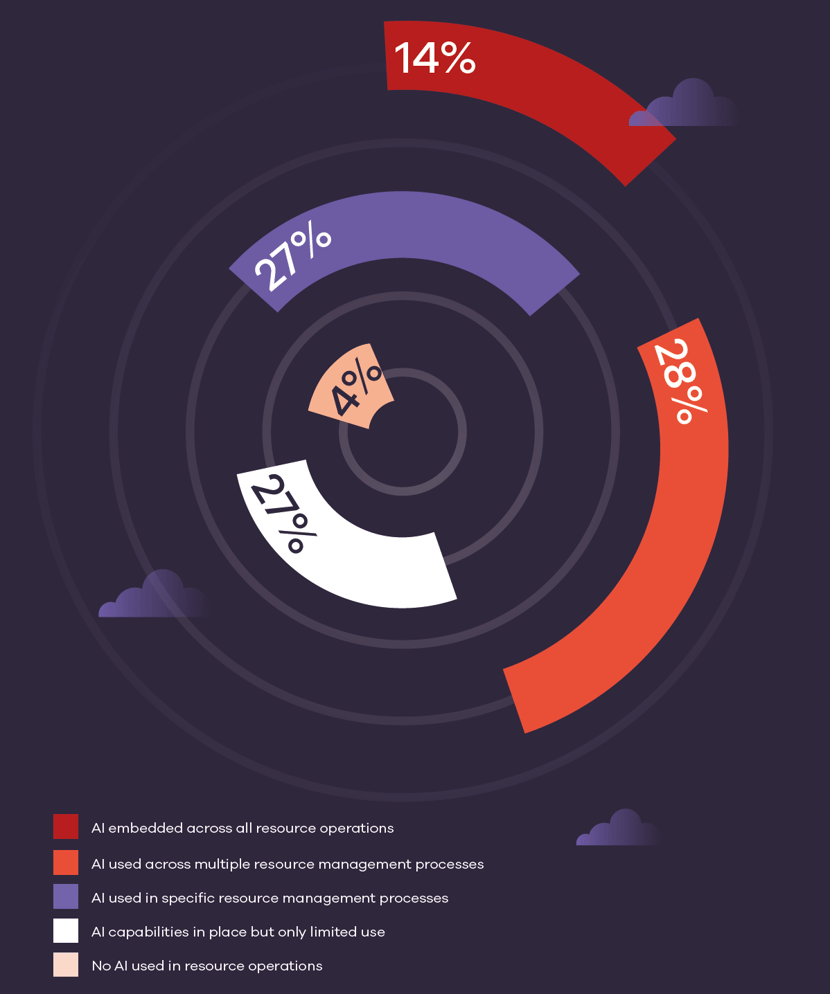
The impact is already visible, but the depth of AI integration varies considerably. Only 14% have fully embedded AI across resource operations.
For most, adoption remains concentrated in specific processes or use cases. More than half (55%) use AI across multiple or specific resource management processes, while a further 27% have AI capabilities in place but are making only limited use of them.
This pattern is reflected in wider industry research. The Resource Management Institute’s 2026 The Emergence of AI in Resource Management report found that while 60% of organizations use AI to support resource management, fewer than 15% use it systematically across the function.
This points to an uneven picture of AI maturity within firms: while AI is already widely used in client delivery, its adoption across the operational capabilities that support that delivery is progressing more slowly. The result is a gap between AI-enabled delivery and the planning and coordination needed to deploy people, AI, and global delivery as one connected system.
Where organizations are realizing the greatest value from AI
Planning maturity remains uneven.
The industry is moving in the same direction, but not at the same pace. The same pattern can be seen in demand forecasting.
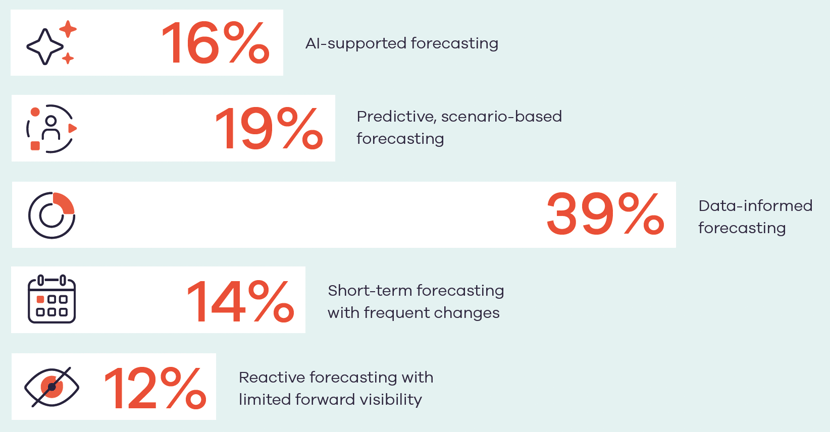
Only 16% of firms have reached AI-supported demand forecasting, while a further 19% use predictive, scenario-based approaches.
For most firms, planning remains grounded in historical and current data rather than predictive intelligence. Despite growing investment in AI, only 4% can accurately forecast workforce capacity more than 12 months ahead.
The opportunity is not simply to introduce AI into existing planning processes, but to use it to extend how far ahead firms can see, model different scenarios across service lines and geographies, and respond earlier as client demand changes.
Demand forecasting maturity
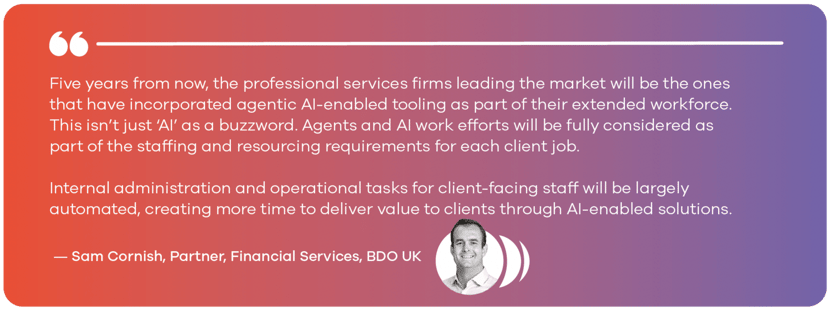
Sector spotlight: Accounting
Accounting firms show signs of more advanced AI adoption across resource operations:
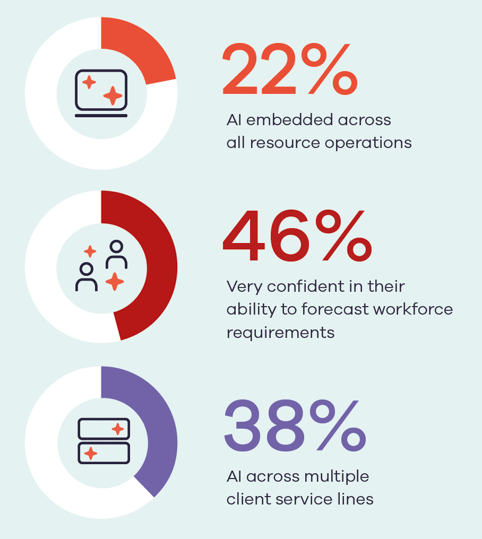
22% have AI embedded across all resource operations, compared with 14% overall
38% use AI across multiple client service lines, compared with 32% overall
46% describe themselves as very confident in their ability to forecast workforce requirements
For firms operating at the scale of the Big Four, where a single service line may span thousands of professionals across multiple geographies, this maturity advantage compounds.
The earlier firms embed AI into resource operations, the greater their ability to coordinate complex, cross-border delivery at pace.
The shift from adoption to integration.
AI has crossed the adoption threshold in professional services. The next challenge is integration.
The firms that gain the greatest advantage will not necessarily be those deploying the most AI, but those that embed it into the operational decisions that shape how work gets delivered.
That means connecting AI with the data, planning processes, and resource decisions that determine capacity, utilization, delivery, and ultimately business performance.
The next phase of AI maturity will be defined not by deploying more AI, but by embedding it more deeply into planning, forecasting, resource allocation, and operational decision making.
Resource operations maturity among accounting firms
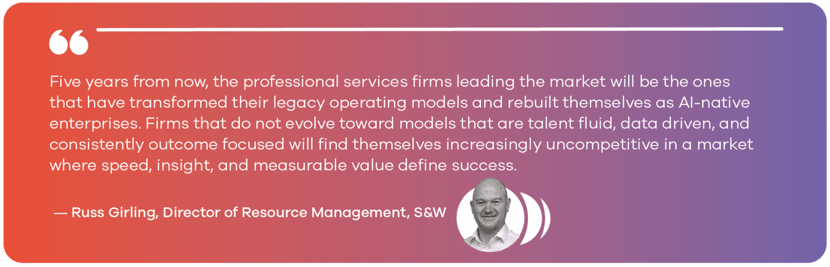
The evidence is clear.
Almost every senior leader surveyed recognizes the importance of resource management to financial performance, while more than four in five view workforce planning as a strategic lever for growth.
Resource management is no longer simply about utilization and scheduling. It is now widely expected to inform workforce planning, commercial decisions, client delivery, and business performance.
Resource management has become a strategic business capability
From visibility to business impact: Then → Now
Comparing findings from Dayshape's 2025 Inside the leadership growth agenda research with this year's survey.
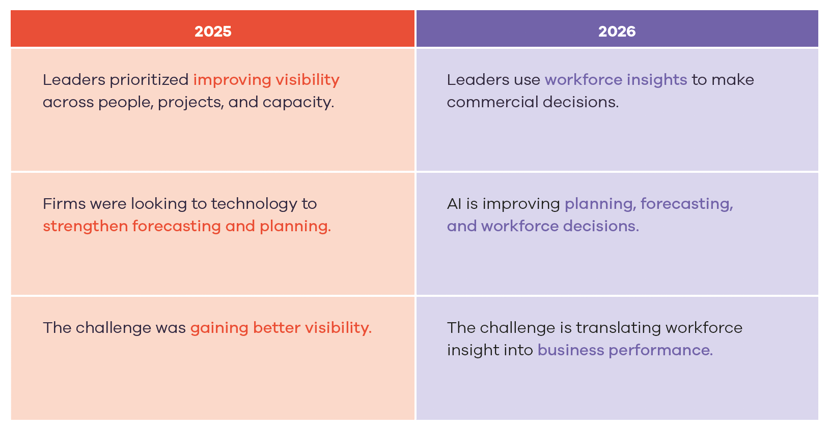
The progression is evident.
Last year’s research showed firms prioritizing technology investment alongside better visibility, forecasting, and operational planning. One year later, the conversation has moved on.
Visibility remains essential, but the expectation now is that workforce intelligence should inform business decisions. 93% say resource management data is already used in executive decision-making, while AI is beginning to strengthen the planning and forecasting capabilities behind those decisions.
Visibility is no longer the destination: it is the foundation.
Confidence versus operational reality: Then → Now
Comparing findings from Dayshape's 2025 Inside the leadership growth agenda research with this year's survey.
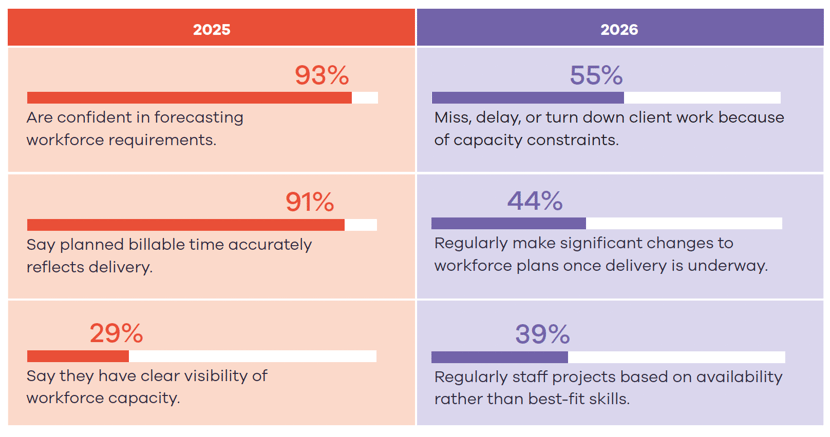
Most organizations are confident in their ability to plan effectively, yet many continue to lose or delay client work because of capacity constraints, rework workforce plans during delivery, and staff projects based on availability rather than suitability.
For large global firms, making that best-fit decision can mean matching skills, industry experience, certifications, and location across thousands of professionals and multiple service lines.
Workforce planning today
The challenge is no longer proving that resource management matters. It is turning that strategic importance into more consistent operational execution.
The tools and approaches supporting workforce planning help explain why that transition remains a work in progress.
Approaches to workforce planning
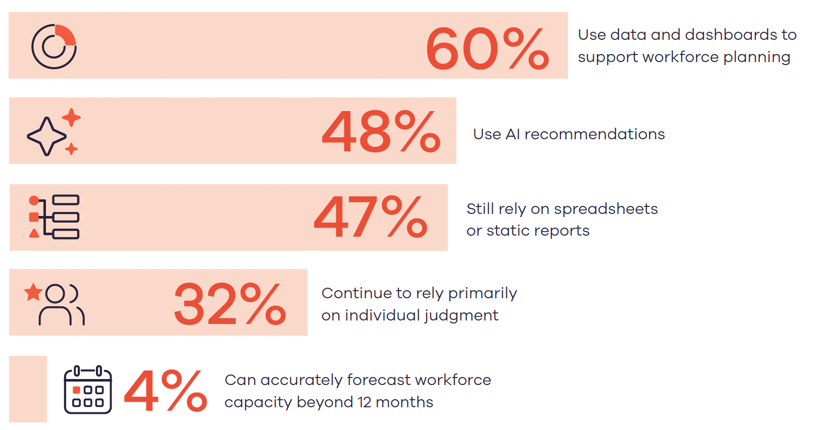
The picture is one of transition. Data, dashboards, and AI are increasingly part of workforce planning, yet spreadsheets, static reports, and individual judgment remain widespread.
76% of leaders say AI is already improving resource planning and allocation decisions. The opportunity now is to build on those gains with more connected, forward-looking planning.
Only 4% of firms can accurately forecast workforce capacity beyond 12 months. As delivery models become more complex, near-term visibility alone will not be enough. Firms need a forward-looking view of both capacity and demand, allowing them to anticipate gaps, model scenarios, and make earlier decisions about how work will be delivered.
That requires more than better forecasting tools. It depends on connected data and technology that bring workforce planning, demand, delivery, and commercial priorities together.
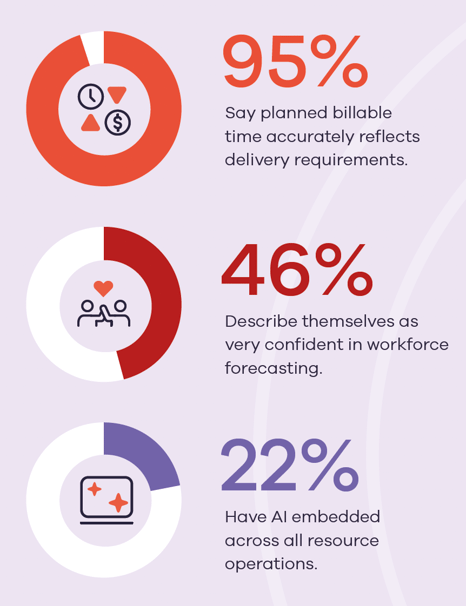
Sector spotlight: Accounting
Accounting firms show signs of greater maturity across several workforce planning measures.
95% say planned billable time accurately reflects delivery requirements.
46% describe themselves as very confident in workforce forecasting.
22% have AI embedded across all resource operations.
The findings indicate that accounting firms may be further along in embedding AI and workforce planning into day-to-day operations, providing an early indication of how these capabilities could evolve across the wider market.
Workforce planning maturity among accounting firms
The control tower for the next operating era
The growing strategic importance of resource management reflects a bigger change in the professional services operating model.
Firms are increasingly combining people, AI, and global delivery to deliver work. As the sources of capacity become more diverse, the task isn’t just understanding what capacity exists. It’s coordinating that capacity against demand, economics, and business priorities.
If we imagine a firm to be an airport, resource management is the air traffic control tower. As airspace becomes busier, better radar provides visibility, but visibility alone cannot coordinate every aircraft.
The control tower must continuously respond to changing conditions and coordinate thousands of interconnected decisions as one system.
Professional services firms face a similar challenge.
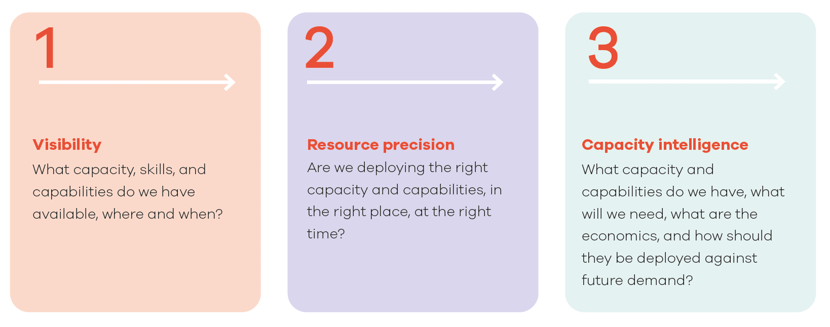
The first generation of workforce planning focused on visibility: where people were, what skills they had, and where capacity existed. That visibility remains essential, but the next operating era demands more.
Firms need to understand the full mix of capacity and capabilities available across people, AI, and global delivery; anticipate what they will need; understand the economics; and continuously align that capacity with demand and commercial priorities.
This is capacity intelligence.
It is coordinating it.
Doing that well requires more than visibility. Firms need to understand the capacity and capabilities available to them, anticipate future demand, understand the economics of different delivery choices, and continuously decide how each source of capacity should be deployed.
The opportunity is to build the operating model that creates a sustainable competitive advantage.
Capacity intelligence is the ability to understand the full mix of capacity and capabilities available across people, AI, and global delivery, anticipate what the business will need next, and continuously align that capacity with future demand, economics, and commercial priorities.
From visibility to capacity intelligence
The capabilities behind capacity intelligence
Building this capability requires firms to connect information that has traditionally been fragmented across the operation. Real-time capacity visibility needs to sit alongside connected data, real-time financial data, and a forward view of demand.
1. Real-time capacity visibility
Capacity, availability, skills, and capabilities across people, AI, and global delivery.
2. Connected data across the firm
Workforce, project, skills, demand, and delivery data connected rather than sitting in silos.
3. Real-time financial data
Revenue, cost, margin, and project economics available to inform decisions as they are made.
4. Future-facing demand and capacity planning
What work is coming, what capacity and capabilities will be required, and where they should come from.
5. Continuous decision-making and coordination
The ability to respond as demand, capacity, economics, and business priorities change.
Together, these capabilities create a more complete, forward-looking view of the business: what capacity and capabilities are available, what demand is coming, what different delivery choices will cost, and how capacity should be deployed against the opportunities ahead.
This is the opportunity at the heart of the next operating era: moving from managing the capacity the business has today to continuously shaping the capacity and capabilities it will need tomorrow.
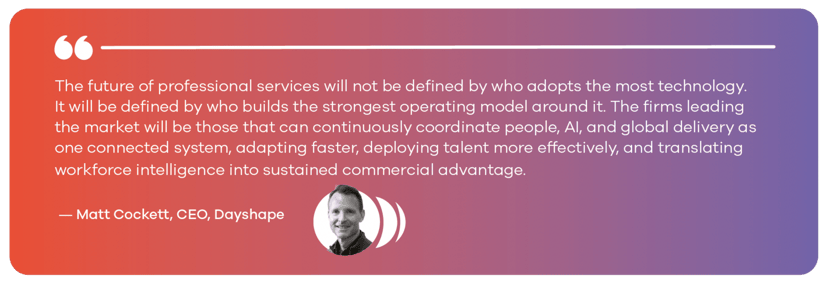
Firms that can bring these capabilities together will be better positioned to make earlier decisions, adapt their delivery model as demand changes, and turn workforce intelligence into stronger execution and more profitable growth.
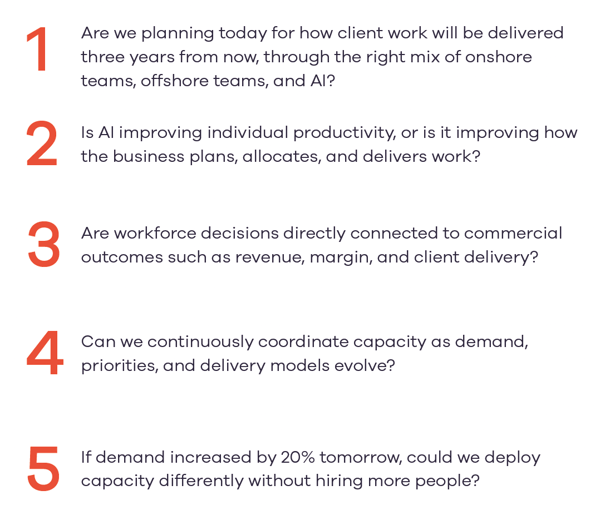
As professional services enters its next chapter, the questions leadership teams ask will become just as important as the technologies they invest in.
Survey audience
Senior leaders at professional services firms in the UK and US with 750+ employees, spanning accounting, assurance, audit, business and management consulting, law, and tax. The sample included 200 respondents from accounting firms.
The survey focused on firm-level priorities, challenges, and investment plans for the year ahead. Questions included a mix of single- and multiple-response formats (e.g., “select up to three” or “select all that apply”).
Data collection and analysis
Data collection was carried out online via OnePoll’s platform, which adheres to the MRS Code of Conduct, ESOMAR guidelines, and British Polling Council standards. OnePoll also upholds commitments to inclusion, equality, and cybersecurity through recognized certifications. The survey was designed and analyzed by Dayshape and ASPR.
Back to all postsExplore our latest insights and strategies for success.


Discover how AI can transform your resource management and enhance your project delivery.