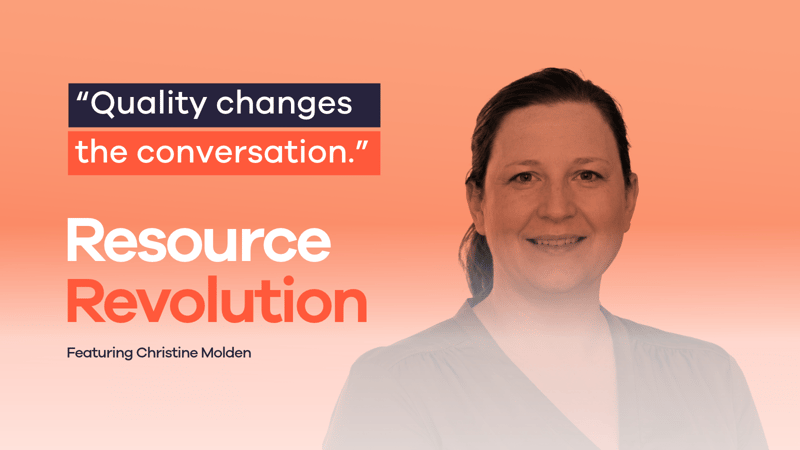
What do resourcing decisions have to do with audit quality, regulatory risk, and equitable opportunities? For Christine Molden, Head of Resourcing at EY UK, the answer is everything.
In this episode of Resource Revolution, Christine joins host Christine Robinson to explore the vital role resource management plays in protecting quality, managing risk, and influencing better business decisions.
Drawing on more than 20 years of experience, Christine shares how resource managers can challenge decisions that put audit quality at risk, use data to uncover inequities in work allocation, and create fairer opportunities. She also explores why asking, “So what?” is key to making resourcing data count, and how AI could create a more consultative role for resource managers.
Tune in to the full conversation below or continue reading to discover why quality changes the conversation for resource management.
“It's not always visible what resource management does.”
When we think about audit quality, resource management might not be the first function that comes to mind. Yet decisions about who delivers the work, how teams are structured, and how workloads are managed can have significant consequences for quality and risk.
For Christine, this is one of the most important, and sometimes overlooked, responsibilities of resource management.
In a regulated audit environment, firms need to demonstrate that the teams delivering client work have the appropriate structure, experience, and skills. They must also be able to justify staffing changes and show that excessive workloads are being managed proactively.
“We sign off on controls that demonstrate that we are providing quality in our teams, in the delivery model, and we are managing risk.” - Christine Molden
The consequences of getting these decisions wrong extend beyond operational inefficiency. Staffing decisions can affect audit quality, regulatory compliance, and ultimately a firm's reputation.
And while the regulatory requirements may be specific to audit, the underlying principles have wider relevance.
Ensuring teams have the right capabilities, are managing workloads responsibly, and are maintaining visibility over critical staffing gaps are important considerations for any professional services firm.
Christine also makes the case for embedding quality into resource management processes from the outset, rather than treating governance as an additional administrative burden.
“Quality gives you clout.”
One of the most powerful points Christine raises is how responsibility for quality changes the influence resource managers can have over business decisions.
Resource managers regularly need to challenge staffing requests, raise concerns about capacity, or recommend changes that may not be popular with engagement leaders.
In a regulated environment, those conversations carry additional weight when a decision can be linked directly to audit quality.
“As soon as you escalate that if you do not make this decision, which is the right decision, then there is a risk from a quality perspective or an ISQM 1 framework, whatever it might be, then people listen.” - Christine Molden
A conversation about moving someone between engagements, addressing a critical shortage, or managing excessive utilization becomes a discussion about protecting the quality of client work and managing the firm's exposure to risk.
As Christine puts it, quality gives resource managers the backing to drive the right action.
And that influence can produce tangible results.
Christine describes how more effective headcount management and reporting have contributed to year-on-year reductions in critical staffing shortages at EY, demonstrating the direct impact resource management can have on reducing risk.
Resource managers who can connect their recommendations to quality, risk, and business priorities are better positioned to influence the decisions that matter.
“Ask yourself, 'So what?'”
Quality is one example of why resourcing data matters. But Christine believes its real value comes from understanding what it means and what action should follow.
Resource management teams have access to a wealth of information, from utilization and capacity to skills, staffing gaps, and demand forecasts.
Presenting that information to leadership is only part of the job.
“Any data that my team produces or I produce, we always ask ourselves, 'What, so what, what is the point of us providing this data?'” - Christine Molden
Take utilization, for example.
An overall utilization figure might tell leaders how busy their people are. Looking more closely at utilization by grade or skill can reveal where expertise is underused, where teams are under pressure, or where future capacity problems may be emerging.
Similarly, tracking changes in the number of people without allocated work can help leaders identify trends and decide whether to adjust staffing, invest in new capabilities, or respond to changes in demand.
For Christine, reporting should lead to a recommendation.
“We will present the bench data. And we will suggest the decision that the business leaders need to make associated with that bench growth or subtraction of the bench.” - Christine Molden
This approach also depends on understanding why resource management processes exist.
Whether the objective is to protect audit quality, improve people's experiences, or make more reliable workforce decisions, explaining that purpose helps build support across the business.
Christine's message for resource managers is: before sharing another dashboard or report, consider what the information reveals, why leadership should care, and what should happen next.
“Anything we can do that drives a better experience for our people is the right thing to do.”
One of the most compelling examples of data influencing decisions comes from Christine's work around equity.
Resourcing decisions determine far more than who is available to deliver an engagement. They also influence who gets exposure to different clients, who develops new skills, and who has access to career-building opportunities.
Those decisions can create inequalities, even when they aren't intentional.
Christine explains how examining utilization through the lens of gender and ethnicity can help reveal differences in people's experiences.
“That had a big impact because it was live data that they couldn't argue with. It provided insight around the choices that they were making every day or resourcing was making every day on their behalf.” - Christine Molden
Making the outcomes of everyday decisions visible can change the conversation with leadership.
If certain groups consistently receive different levels of billable work, that raises questions about how opportunities are allocated, whose skills are recognized, and whether established working relationships are influencing decisions.
Rather than relying on assumptions about fairness, resource managers can use evidence to identify patterns and challenge the decisions behind them.
But equity also depends on giving people greater visibility and a voice in the process.
Christine discusses how EY's Marketplace allows individuals to see upcoming opportunities and express an interest in assignments that could develop their skills, even when they don't yet have all the experience required.
For resource managers, this creates an opportunity to connect immediate staffing needs with longer-term career development.
“It makes me proud because it feels like we're doing something tangible to make a difference to people.” - Christine Molden
“The human is always at the center of any decision.”
As AI and automation change how professional services firms operate, Christine sees significant potential for the role of resource management to evolve.
Technology is already changing how firms understand skills, match people to work, and use workforce data. Further automation could reduce some of the manual effort involved in managing supply and demand.
But Christine is clear about the importance of human judgment.
“The human is always at the center of any decision that's made for a matching of supply and demand, for acting on the data and insight we provide.” - Christine Molden
People need to trust the decisions being made about their work and careers. That requires relationships, context, and an understanding of individual circumstances that extends beyond what a system can tell us.
Where Christine sees the greatest opportunity is in how technology could change what resource managers spend their time doing.
Today, the constant demands of allocating work, responding to changes, and managing immediate capacity can limit the time available for longer-term thinking.
As more of that operational activity becomes technology-enabled, resource managers could have greater scope to advise business leaders and influence workforce strategy.
“I think it'll be much more focused on leadership insight, influencing, workforce planning, quality, [...] and experiences of people that people would love to get to today, but the day-to-day churn of the management of supply and demand actually prevents them.” - Christine Molden
That future will require resource managers to develop their consultative capabilities alongside their understanding of data and technology.
It will also require firms to think carefully about how AI changes the skills needed to deliver client work, and how those changes affect future workforce demand.
For Christine, keeping pace with that evolution is essential.
“We can't be on the back foot.” - Christine Molden
The opportunity is for resource management to spend less time consumed by immediate allocation challenges and more time helping firms anticipate what comes next.
Throughout the conversation, Christine makes a compelling case for the influence resource management already has, and the opportunity to extend it further.
From protecting audit quality and challenging decisions that introduce risk, to identifying inequities and advising on future workforce needs, the consequences of resourcing decisions reach across the business.
The common thread is understanding what those decisions mean for quality, people, and performance, and having the confidence to act on that understanding.