
Request a Dayshape demo
Get in touch and learn first-hand how Dayshape can help boost profitability, improve client service, and keep your teams happy.

Platform
Optimize margins. Grow revenue.
Plan reliably. Act confidently.
Inspire teams. Delight clients.
Enterprise scalability
Use Cases
By role
10 ways for resource managers to elevate their impact
Elevate your role, expand your influence, and drive impact across your firm.
Listen nowCustomer Success
Company
Resources
Resources
Featured resources
Live webinar: See Dayshape Agent in action

On November 2, join Melissa Owens (formerly Forvis Mazars US) and Andrew Bone for a live look at Dayshape Agent to learn how resource and operational leaders can get to the insight they need faster and make more confident decisions.
Register nowThe role of strategic resource management in QC 1000 readiness

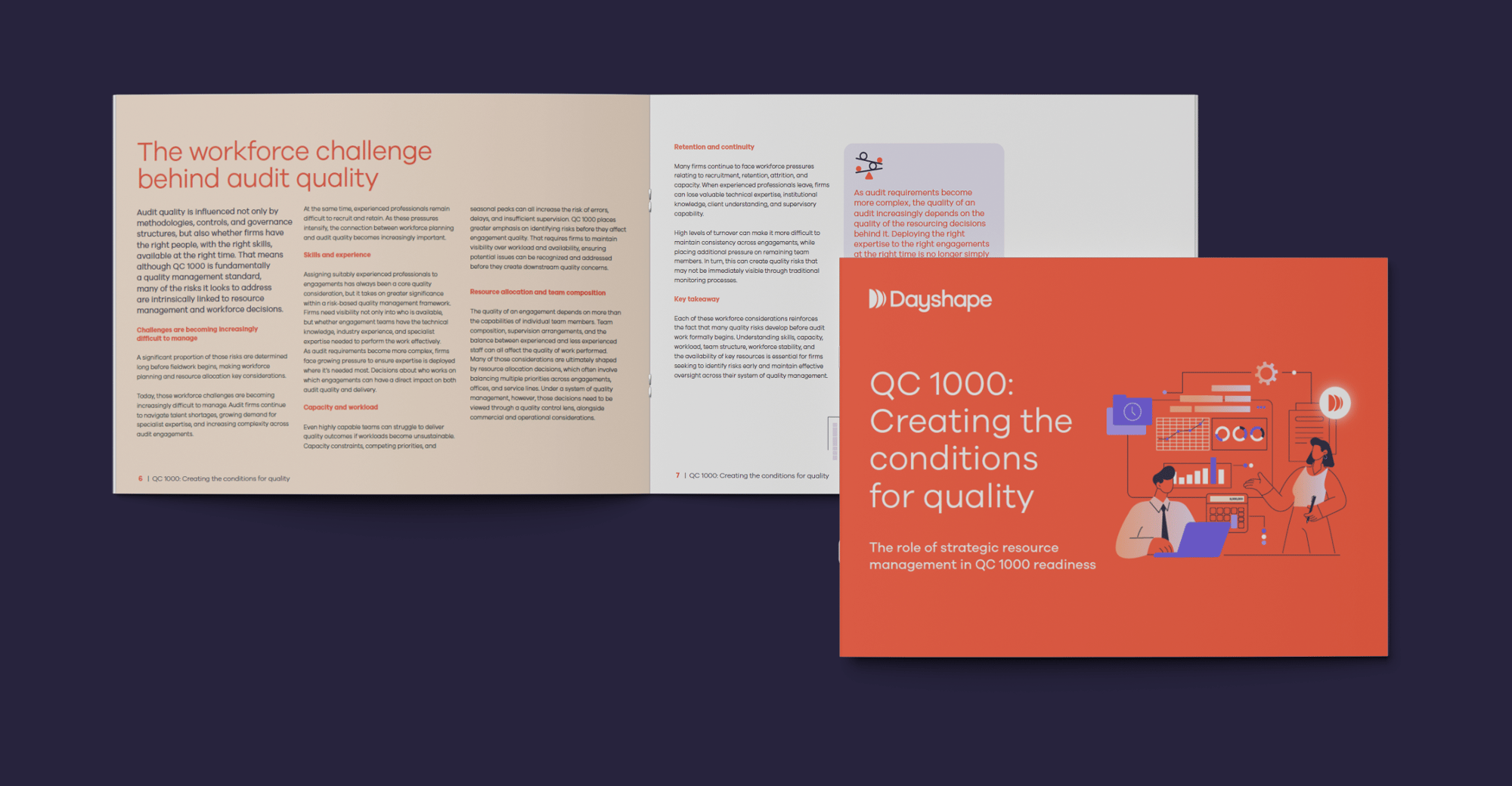
While much of the discussion surrounding QC 1000 focuses on quality control systems and regulatory requirements, many of the conditions that affect audit quality are determined through everyday decisions around staffing, supervision, workload management, and resource allocation. As a result, workforce planning and resource management have an increasingly important role to play in supporting quality outcomes.
This guide explores the relationship between QC 1000 and resource management, examining how workforce capability, capacity, governance, and risk management contribute to effective quality management. Intended for senior professional services leaders, operational leaders, and resource management leaders, it provides a practical framework for understanding the workforce-related risks that influence audit quality, and why strategic resource management is becoming an increasingly important control point for firms preparing for QC 1000.
The new quality control standard
Setting out how firms should design, implement, and operate a system of quality control, QC 1000 represents a significant change in approach. The scale of that change is reflected in the implementation timeline, with the effective date ultimately pushed back by a year to give firms more time to prepare.
It replaces a more traditional quality control model with a proactive, risk-based system of quality management. While QC 1000 remains a distinct PCAOB standard, firms familiar with ISQM 1 will recognize a similar emphasis on risk-based quality management. Rather than treating quality as a compliance exercise, QC 1000 pushes firms toward something more demanding — a system that embeds accountability and ethical culture into everyday operations, and identifies quality risks before they affect engagement outcomes. The underlying principle is that quality management should be continuous and firm-wide, rather than something that comes into focus only when issues emerge.
To support that objective, QC 1000 covers a lot of ground. It’s built around eight interconnected components covering risk assessment, governance and leadership, ethics and independence, acceptance and continuance of engagements, engagement performance, resources, information and communication, and monitoring and remediation. Together, these components are designed to operate as an integrated system rather than a collection of standalone requirements. The standard places particular emphasis on governance, leadership, and accountability, with ultimate responsibility for the firm’s system of quality control resting with its principal executive officer. The requirement reflects a broader move toward stronger oversight and system-level ownership of audit quality, ensuring responsibility sits at the highest level of the organization rather than within individual engagement teams alone.
QC 1000 at a glance
• Replaces existing PCAOB quality control standards
• Applies to all PCAOB-registered public accounting firms
• Built around eight interconnected quality control components
• Effective from December 15, 2026
Firm-wide accountability
That change has major implications. Under QC 1000, quality is no longer viewed solely as the responsibility of engagement teams or quality specialists. Instead, accountability extends right across the firm, with leadership expected to take ownership of how quality is governed, monitored, and continuously improved. The requirement for the principal executive officer to hold ultimate responsibility for the firm’s system of quality control reinforces that expectation, placing organizational accountability firmly at the leadership level.
Evidence-based oversight
The standard also raises the bar for oversight. Firms must be able to demonstrate not only that quality processes exist, but that they’re operating effectively in practice. This places greater emphasis on monitoring, reporting, and evidence-backed decision making. Firms need to understand where quality risks may occur, how those risks are being assessed, and whether appropriate actions are being taken in response.
Better-informed decisions
Many of the drivers of audit quality sit outside the engagement itself. Decisions around staffing, supervision, workload management, skills, experience, and capacity all shape the environment in which audit work is delivered. They also influence broader firm outcomes, including delivery confidence, operational resilience, and ultimately the ability to protect quality at scale.
Key takeaway
For operational and firm leaders, QC 1000 is more than a compliance exercise. It creates a need for stronger governance, better information, and a clearer understanding of the operational factors that influence quality across the firm. Ultimately, it places greater emphasis on system-level accountability for audit quality.
Challenges are becoming increasingly difficult to manage
A significant proportion of those risks are determined long before fieldwork begins, making workforce planning and resource allocation key considerations. Today, those workforce challenges are becoming increasingly difficult to manage. Audit firms continue to navigate talent shortages, growing demand for specialist expertise, and increasing complexity across audit engagements.
At the same time, experienced professionals remain difficult to recruit and retain. As these pressures intensify, the connection between workforce planning and audit quality becomes increasingly important.
Skills and experience
Assigning suitably experienced professionals to engagements has always been a core quality consideration, but it takes on greater significance within a risk-based quality management framework. Firms need visibility not only into who is available, but whether engagement teams have the technical knowledge, industry experience, and specialist expertise needed to perform the work effectively. As audit requirements become more complex, firms face growing pressure to ensure expertise is deployed where it’s needed most. Decisions about who works on which engagements can have a direct impact on both audit quality and delivery.
Capacity and workload
Even highly capable teams can struggle to deliver quality outcomes if workloads become unsustainable. Capacity constraints, competing priorities, and seasonal peaks can all increase the risk of errors, delays, and insufficient supervision. QC 1000 places greater emphasis on identifying risks before they affect engagement quality. That requires firms to maintain visibility over workload and availability, ensuring potential issues can be recognized and addressed before they create downstream quality concerns.
Resource allocation and team composition
The quality of an engagement depends on more than the capabilities of individual team members. Team composition, supervision arrangements, and the balance between experienced and less experienced staff can all affect the quality of work performed. Many of those considerations are ultimately shaped by resource allocation decisions, which often involve balancing multiple priorities across engagements, offices, and service lines. Under a system of quality management, however, those decisions need to be viewed through a quality control lens, alongside commercial and operational considerations.
Retention and continuity
Many firms continue to face workforce pressures relating to recruitment, retention, attrition, and capacity. When experienced professionals leave, firms can lose valuable technical expertise, institutional knowledge, client understanding, and supervisory capability. High levels of turnover can make it more difficult to maintain consistency across engagements, while placing additional pressure on remaining team members. In turn, this can create quality risks that may not be immediately visible through traditional monitoring processes.
Key takeaway
Each of these workforce considerations reinforces the fact that many quality risks develop before audit work formally begins. Understanding skills, capacity, workload, team structure, workforce stability, and the availability of key resources is essential for firms seeking to identify risks early and maintain effective oversight across their system of quality management.
Risk visibility and assessment
A central principle of QC 1000 is that firms should monitor, identify, and address quality risks before they affect audit quality. Skills shortages, capacity constraints, workload imbalances, siloed staffing decisions, and gaps in supervision can all increase the likelihood of quality risk. Resource-related risks aren’t always immediately visible. Capacity constraints may develop gradually, specialist skills may become concentrated within a small number of individuals, and workload pressures may build across teams before they become apparent at engagement level.
To take a proactive rather than reactive approach, firms need visibility into future commitments, resource availability, engagement demands, and workforce capability so they can understand where pressures may be developing. The ability to access, share, and act on this information supports stronger decision making and helps ensure potential risks are identified early. It also helps ensure that relevant information reaches the people responsible for planning work, managing resources, and overseeing quality across the firm.
Governance and oversight
QC 1000 places significant emphasis on governance, accountability, and monitoring. For leadership teams, that creates a need for greater oversight of the operational factors that influence quality. Resource management provides valuable information about many of those areas. Understanding how work is distributed, where capacity pressures exist, how staffing decisions are being made, and whether engagement teams are appropriately supported provides valuable insight into potential quality risks.
This becomes particularly relevant in a system of quality control that places accountability with senior leaders, who are expected to establish appropriate governance structures and ensure they operate effectively. Access to reliable operational information helps support that responsibility, giving greater confidence that quality risks are being identified, monitored, and appropriately addressed.
Visibility into these conditions also supports monitoring and improvement activities. Where recurring issues arise, firms are better positioned to investigate underlying causes, assess whether workforce factors may be contributing, and take appropriate action.
Resourcing quality
The standard recognizes that quality outcomes are influenced by the resources available to support engagement delivery. While resources encompass more than people, resource management decisions remain a significant factor. Assigning appropriately skilled professionals, balancing workloads, providing effective supervision, and ensuring sufficient capacity all contribute to engagement performance. Resource management helps align workforce decisions with broader quality objectives while supporting the delivery of quality work. workforce decisions with broader quality objectives while supporting the delivery of quality work.
Methodology alone doesn’t determine audit quality. It also depends on whether teams have access to the specialist knowledge, time, supervision, and support needed to perform their work to the expected standard. Decisions around scheduling, staffing, and workload management therefore have a direct influence on the environment in which quality is delivered.
Key takeaway
Through the lens of QC 1000, resource management becomes a strategic quality control point rather than an administrative process. It helps firms understand whether they have the right people, capacity, supervision, and oversight in place to support consistent audit quality. Those capabilities will be increasingly important as firms prepare for the new standard.
1. Can we identify quality risks before they affect delivery?
One of the central objectives of QC 1000 is to identify and address quality risks before they affect engagement outcomes. For many firms, that begins with assessing whether potential issues can be spotted early enough for effective intervention. Skills shortages, workload pressures, supervision challenges, and capacity constraints don’t usually appear overnight. More often, they develop gradually across teams, offices, or service lines. Firms should consider whether they have sufficient visibility into these conditions and whether emerging risks can be recognized before they begin to affect engagement delivery.
2. Do we have a clear view of capacity and workload?
Workload and capacity pressures are one of the most common operational challenges faced by professional services firms. Competing priorities, seasonal demand, staff absences, and changing scope can all influence how work is distributed across the organization. It’s worth considering how consistently capacity is monitored and whether leadership teams have access to accurate, up-to-date information about workload levels across different teams and engagements. Understanding where pressure points exist can help firms make more informed decisions about resourcing, supervision, and risk management.
3. Are we consistently assigning the right people to the right engagements?
Audit quality depends in part on ensuring engagements are supported by people with the appropriate skills, experience, and expertise. However, consistency can become more difficult to maintain as firms grow, service lines expand, and specialist skills become more concentrated. Firms should consider how staffing decisions are made, what information informs those decisions, and whether engagement teams are consistently receiving the level of experience and supervision required. Reviewing these processes can help identify areas where workforce decisions may introduce unnecessary quality risk.
4. Do leaders have the visibility they need?
QC 1000 places significant responsibility on firm leadership for the effectiveness of the overall system of quality control. That responsibility relies on access to reliable information about the operational conditions that influence quality. Leaders should consider whether they have the right level of insight into workforce capacity, engagement demands, staffing decisions, quality risks, and remediation activities. Effective oversight depends not only on governance structures, but also on the quality, consistency, and accessibility of the information used to support decision making.
5. How quickly can we respond when risks emerge?
Identifying risks is only one part of the challenge. Firms also need to consider how effectively they can respond once potential issues have been identified. Where capacity pressures, resource constraints, or quality concerns develop, are there clear, workable processes for escalation and intervention? Can critical decisions be made quickly enough to prevent issues from affecting engagement delivery? The ability to respond in a timely manner is often just as important as the ability to identify risks in the first place.
That means operational readiness depends on the maturity of the structures, processes, information, and controls that support those objectives. While every firm’s approach will differ, the following areas can provide a useful starting point.
Develop a workforce risk framework
To detect risks before they affect quality outcomes, a practical starting point is to build a structured understanding of the workforce-related conditions that may influence engagement delivery.
Capacity constraints, skills shortages, workload pressures, turnover, reliance on key individuals, and gaps in supervision can all have a negative impact on audit quality. Developing a workforce risk framework helps firms document, monitor, and assess these conditions more consistently, creating a clearer picture of where additional oversight, intervention, or support may be needed. It also provides a useful foundation for broader quality management activities, helping firms move beyond individual engagements and develop a more complete understanding of the workforce and operational dynamics that impact quality right across the organization.
Define accountability structures
QC 1000 places responsibility for the firm’s system of quality control at the leadership level. As a result, it’s essential to understand who owns workforce planning activities, who monitors potential risks, who reviews operational information, and who is responsible for responding when concerns arise.
Typically this involves multiple stakeholders, with resource management teams, engagement leaders, operational leaders, quality functions, and firm leadership all playing a role in identifying and addressing risks. Well-defined responsibilities help support stronger oversight and provide confidence that quality-related risks are being actively managed across the organization.
Create a trusted operational data foundation
Many of the decisions that influence audit quality rely on operational information. Workforce planning, resource allocation, quality monitoring, leadership reporting, and oversight all depend on access to accurate, timely, and consistent data. Bringing that information together can become increasingly challenging as organizations grow. Data is often distributed across multiple systems, spreadsheets, and reporting processes, making it more difficult to maintain a complete view of workforce capacity, skills, engagement commitments, and workload pressures. Information gaps and inconsistencies can also limit visibility into developing risks and reduce confidence in decision making.
To address these challenges, many firms are exploring how resource management software, analytics, forecasting, automation, and AI-powered planning tools can help improve forecasting, strengthen planning, and support earlier identification of emerging workforce-related risks.
Establish consistent escalation pathways
Effective quality management relies on clear processes for reviewing concerns, escalating risks, assigning ownership, and tracking actions through to resolution. Documented escalation pathways help ensure issues are handled consistently regardless of where they originate within the organization. They support monitoring and remediation activities by creating greater transparency around how risks are assessed, managed, and addressed, while helping ensure potential issues receive appropriate attention before they begin to affect quality.
Key takeaways
Operational readiness for QC 1000 isn’t achieved through a single policy, process, or tech investment. It develops through mature resource management capabilities, clear accountability, reliable operational information, and consistent risk management practices that help firms identify and address quality risks early.
Many of those factors sit within day-to-day operational activities. Workforce planning, resource allocation, supervision, capacity management, and access to reliable information all contribute to the environment in which work is delivered. Understanding these conditions, and how they affect quality, is central to effective quality management.
Preparing for QC 1000 therefore involves more than implementing new policies or meeting regulatory requirements. Firms need the visibility, oversight, and operational control that will enable them to identify emerging risks, respond consistently when concerns arise, and maintain confidence in the effectiveness of their quality management processes.
Resource management becomes more than an administrative function. It becomes a strategic control point for audit quality, supporting better-informed decision making, ongoing monitoring, and earlier intervention across the organization.
Quality management is most effective when it’s continuous rather than reactive. By combining strong governance, reliable operational information, and mature resource management capabilities, firms can develop a more proactive approach to identifying, assessing, and responding to risks before they emerge as issues.
In doing so, quality management becomes an ongoing discipline instead of a periodic exercise, creating a stronger connection between operational decisions and quality outcomes.
QC 1000 isn’t just a compliance exercise. It challenges firms to move from reacting to quality issues to creating the conditions that prevent them. Resource management provides the strategic control point that enables firms to do exactly that
 Resource management is more than an administrative function. For firm leaders, it provides a strategic control point for proactively managing risk and protecting quality.
Discover how AI can transform your resource management and enhance your project delivery.